
Community, Diversity, Sustainability and other Overused Words


Community, Diversity, Sustainability and other Overused Words
Special mention for San Diego International Airport (SAN), because its proximity to downtown creates operational challenges, despite a 10,000 foot runway
Cockpit view during final approach over downtown buildings, water, and dense cityscape - one of the most visually dramatic approaches in the U.S. Youtube.com
Aerial view of John Wayne airport showing the compact runway layout nestled among dense residential and commercial areas
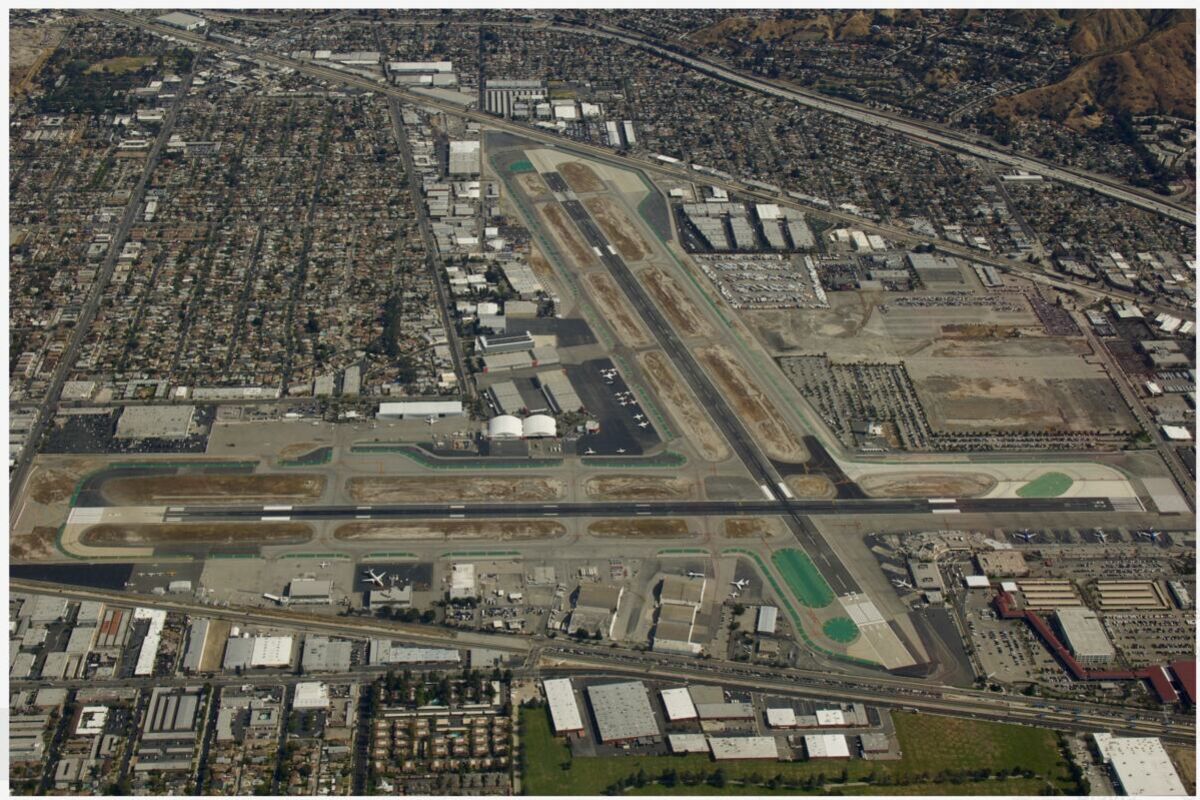
Aerial overview of Burbank airport and its relatively short runways surrounded by urban development and hills
Short runways at commercial airports demand precise piloting, weight restrictions on aircraft, and careful performance calculations, especially in hot weather, high density altitude, or with tailwinds. Only airports with scheduled passenger service from major carriers (or their regional affiliates) are considered here. Runway lengths refer to the longest or primary commercial runway(s).
1. Hilton Head Island Airport (HHH / HXD), South Carolina – 5,000 feet
This holds the title for the shortest runway serving scheduled airliner flights in the US. The single runway (3/21) is just 5,000 feet long and only 100 feet wide (narrower than standard), with displaced thresholds due to surrounding trees that further reduce usable landing distance.
Service: American Eagle (Embraer E170/E175), with seasonal Delta Connection and United Express.
Challenges: Pilots must use full flaps, maximum braking, and touch down in the first 1,000 feet. Jet service began in 2018 after a runway extension.
Incidents: No major reported accidents tied directly to the runway length in public records, thanks to strict operational limits and regional jet use.
2. Key West International Airport (EYW), Florida – 5,076 feet
The single runway (9/27) measures 5,076 feet by 100 feet. Its island location and popularity with tourists limit larger aircraft, favoring Airbus A319s, A220s, Boeing 737-700s, and turboprops.
Service: American Airlines, Delta, JetBlue, United, Allegiant, and Silver Airways.
Challenges: Weight restrictions apply, especially on departures. The airport's southernmost position in the contiguous US adds heat and humidity factors.
Incidents: No significant runway overrun accidents prominently linked to length; operations emphasize short-field techniques.
3. Ronald Reagan Washington National Airport (DCA), Virginia – 5,204 feet (Runway 15/33)
While the primary Runway 1/19 is much longer, the secondary Runway 15/33 is one of the shortest at a major hub. Proximity to the Potomac River constrains it.
Service: All major carriers (American, Delta, United, Southwest, JetBlue, etc.) operate here, though Runway 15/33 is used more for regional jets and departures.
Challenges: Tight approaches, security restrictions, and high traffic. It helps manage congestion during south flow operations.
Incidents: The airport's overall design (including short-ish runways ending near water) has been noted in safety discussions, but no recent major accidents are directly attributed to this specific runway's length.
4. John Wayne Airport (SNA), California – 5,700 feet (Runway 2L/20R)
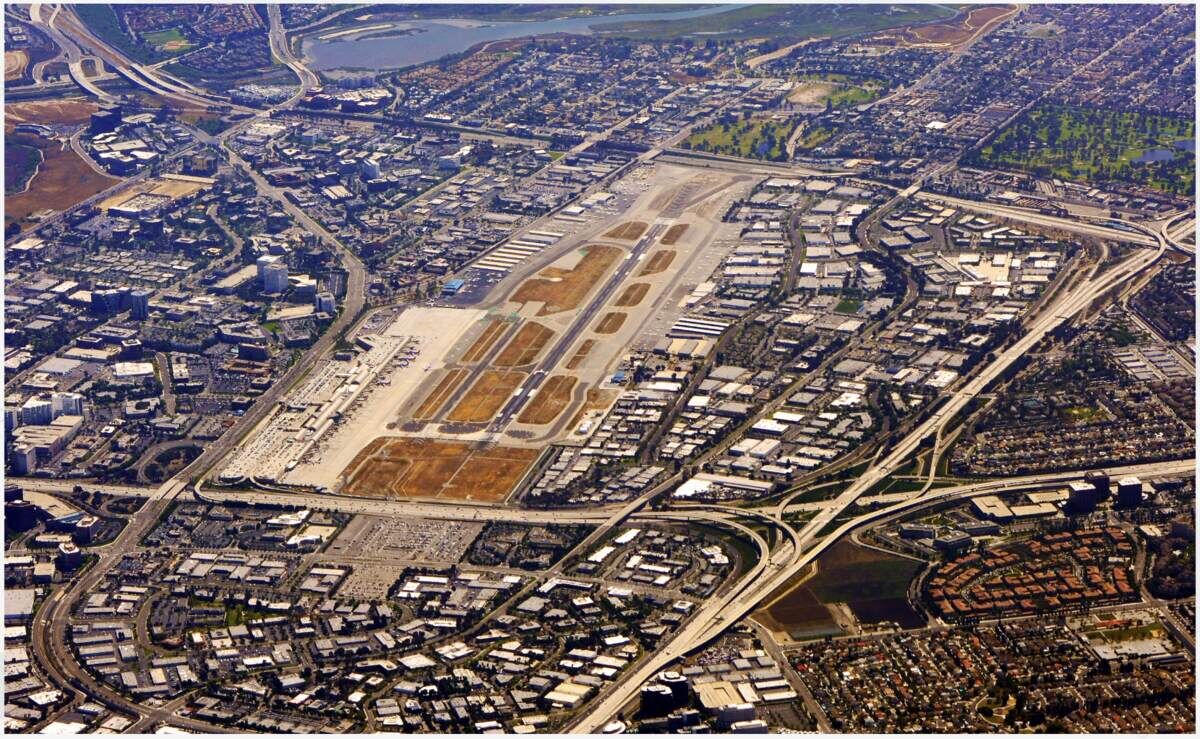
Aerial view of John Wayne airport showing the compact runway layout nestled among dense residential and commercial areas
Often cited as one of the shortest "major" commercial runways, it serves the busy Orange County area as a reliever to LAX.
Service: All major US carriers plus some international and low-cost airlines.
Challenges: Famous for steep "John Wayne" departures due to noise abatement procedures over nearby residential areas. Pilots follow strict climb profiles.
Incidents: No major runway-related accidents reported; procedures and aircraft performance limits keep it safe.
5. Hollywood Burbank Airport (BUR), California – 5,802 feet (Runway 8/26)
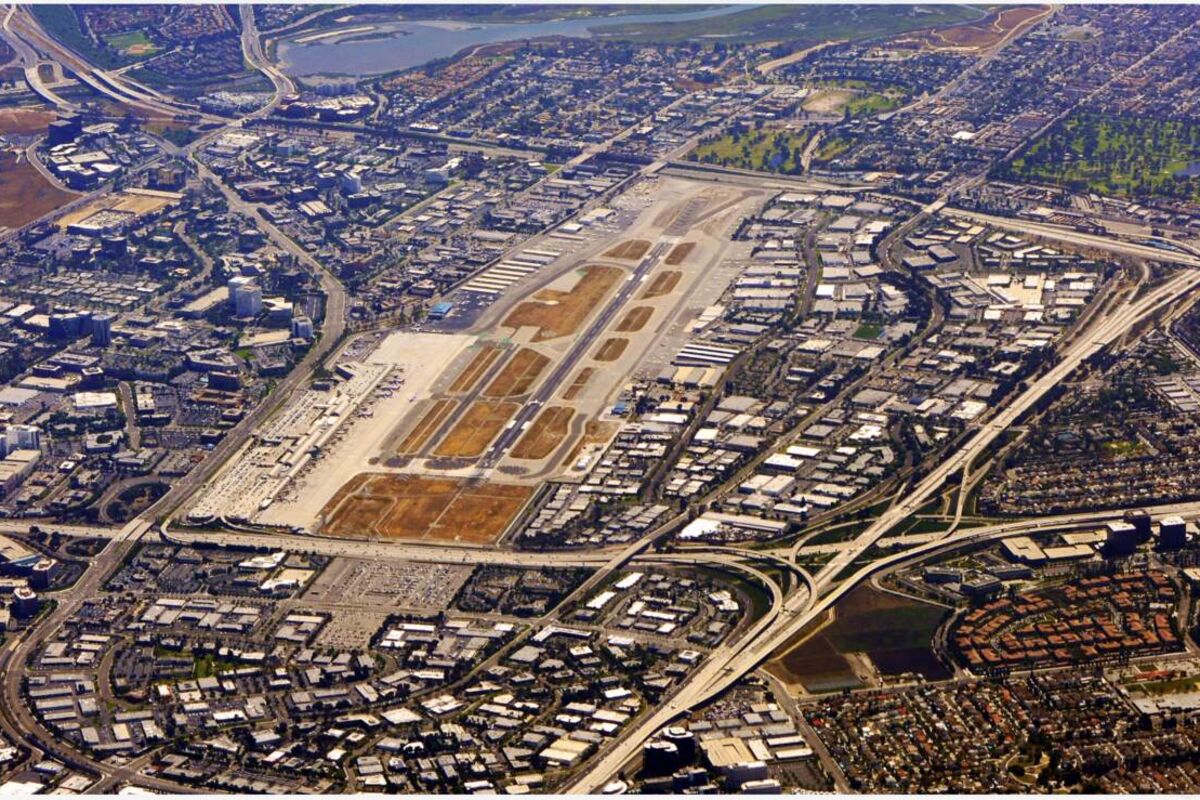
Aerial view of John Wayne airport showing the compact runway layout nestled among dense residential and commercial areas
This urban airport in the Los Angeles area has a longer parallel runway, but Runway 8/26 is frequently used and notably short.
Service: Alaska, American, Delta, Southwest, and others.
Challenges: Surrounded by mountains and dense development.
Incidents: In 2000 and 2018, Southwest 737s overran on the short, wet runway (both stopped safely by EMAS with no fatalities).
Special Mention: San Diego International Airport (SAN), California
Although its single runway (9/27) measures a more respectable 9,401 feet, San Diego International is the busiest single-runway airport in the United States and earns a special mention due to its uniquely challenging operational environment. The approach to Runway 27 is famously steep, requiring pilots to descend sharply over downtown San Diego's tall buildings, a parking garage, utility poles, and the crest of Bankers Hill. The usable landing distance is further reduced by displaced thresholds (1,000 ft on Runway 9 and 1,810 ft on Runway 27).
Service: All major carriers with a full range of narrowbody and some widebody flights.
Challenges: The combination of a relatively constrained runway length for its traffic volume, urban obstacles, shifting winds, and occasional fog creates one of the more demanding approaches in the U.S. commercial aviation system. It has been compared to historic "extreme" approaches like the old Hong Kong Kai Tak.
Incidents: While no major runway-overrun accidents have been directly caused by these factors in recent years, the airport frequently appears on FAA "hot spot" lists for potential runway incursions due to high traffic volume on a single runway. Safety is maintained through strict procedures, but the visual drama (and occasional passenger anxiety) during final approach remains notable.
Safety Context and Broader Issues
Short runways increase the risk of runway excursions (overruns), particularly in wet or contaminated conditions, but U.S. airports mitigate this with Engineered Materials Arresting Systems (EMAS), weight limits, specialized pilot training, and performance data. Historic incidents, such as the 2005 Southwest overrun at Chicago Midway, highlighted short-runway risks and prompted industry-wide improvements.
These airports prove that with the right aircraft, procedures, and infrastructure, constrained runways can operate safely and efficiently - often in scenic or space-limited locations where longer runways simply aren't feasible. Always check specific flight details, as weather and aircraft type heavily influence operations.

Reader Comments(0)