
Community, Diversity, Sustainability and other Overused Words


Community, Diversity, Sustainability and other Overused Words
LA is the predictable outcome of a system that combines no-ID mail-in voting, ultra-lenient signature verification, centralized ballot mailing to homeless hubs, and a court ruling that protects the right to vote while leaving the door wide open to industrial-scale harvesting
Pratt himself tweets: "A net swing of more than 43,000 votes since Tuesday.. 43,000, huh? Where have I seen that number before...? Probably nothing. 🤷" and then showing a report that LA has 43,000 homeless people.
Map from @CINYC9 on Twitter, shows that Raman is receiving a lot of late counted votes from Downtown Los Angeles, the center of homeless encampments in LA County. 30,000 homeless people live there.
"Smiley face signature" on a ballot has gone viral since Houman Hemmati posted it.
Eyewitness accounts and vote data from the June 2026 Los Angeles mayoral primary paint a disturbing picture of how late mail-in ballot "drops" in Downtown LA (DTLA) are disproportionately boosting one candidate: Nithya Raman. This explains why after June 2, the race for LA Mayor shifted from Spencer Pratt and Towards Nithiya Raman to finish second and make the November runoff against Karen Bass, who allowed the Palisades to burn down.
Pratt himself says: "A net swing of more than 43,000 votes since Tuesday.. 43,000, huh? Where have I seen that number before...? Probably nothing. 🤷" and then showing a report that LA has 43,000 homeless people.
Jennifer Callahan says she spent time at the LA County Ballot Processing Center and posted a detailed thread about what she personally witnessed and was told by staff. Her tweets (you can believe it or not) reveal a system seemingly designed for minimal scrutiny:
- "Signatures only need to be 40% accurate (!) this is the setting the machines are set at for LA County (called the ASV)"
- On the last two ballot drops: "The last two drops disproportionately supported Raman. Are those coming from specific neighborhoods since they're such an anomaly? ... 'We're not sure.'"
- "If you're unable to sign, you can make a 'mark' like a dot or slash instead of signing. A witness then signs below." When she asked how they verify these "marked" ballots: "I asked them how they verify these signatures. Turns out, they simply don't."
- On witness signatures: "Well, you must check the witness signatures, right? 'No, we don't.'"
- Hypothetical fraud test: "So what if I stole a ballot, made a dash by the person's name, and signed my name? 'You shouldn't do that, but in theory it would be counted,' they said."
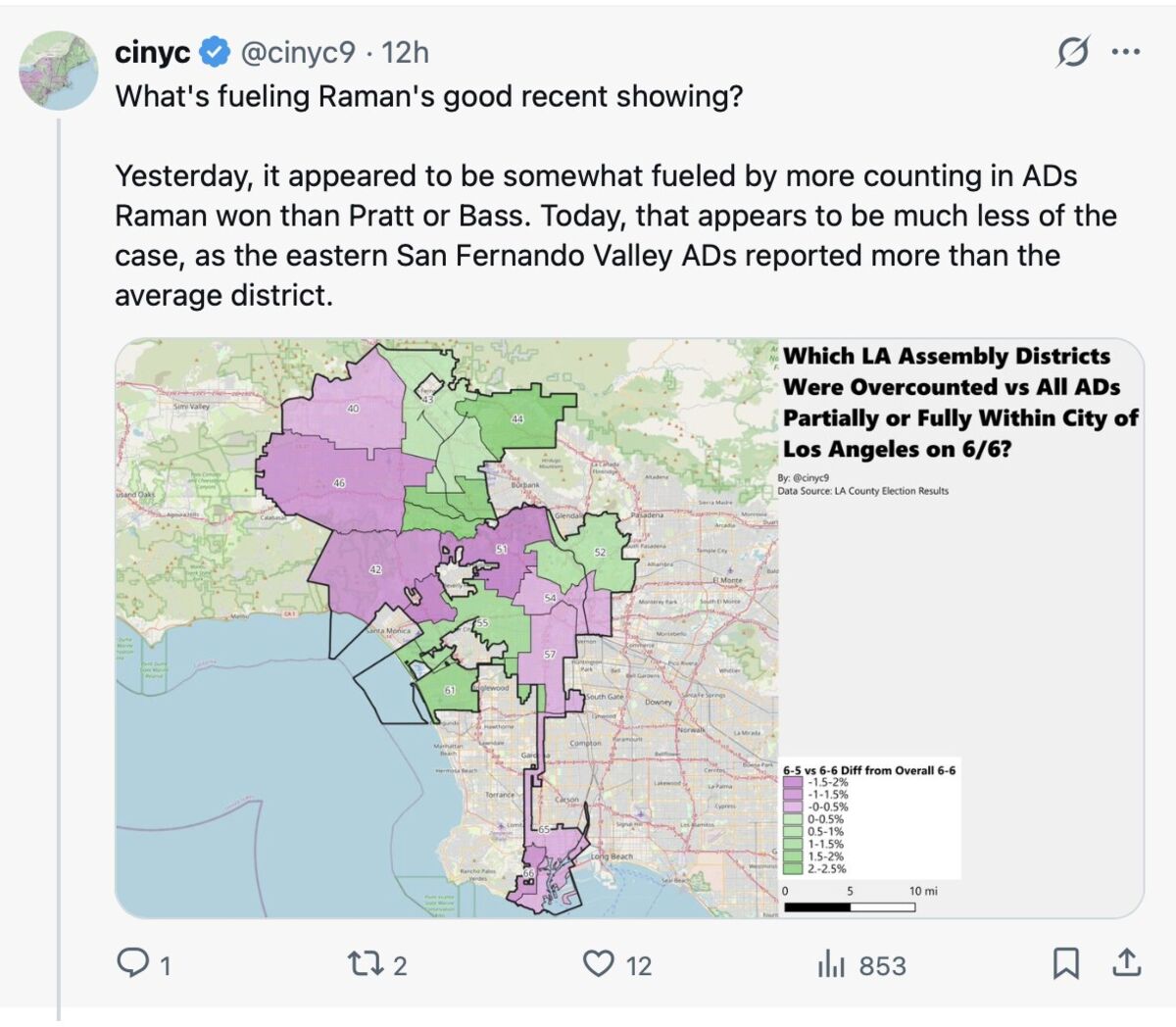
Map from @CINYC9 on Twitter, shows that Raman is receiving a lot of late counted votes from Downtown Los Angeles, the center of homeless encampments in LA County. 30,000 homeless people live there.
- Volume of such ballots: "How many of these 'marked' ballots get in per election? 'We don't know,' they said."
Callahan summed it up plainly: "Ripe for fraud, no?"
That matches data showing massive overcounting in DTLA. Posts analyzing the late mail-in surge highlight that Raman's unexpected jump came in large part from ballots tied to Skid Row - the heart of Downtown Los Angeles' homeless population. Tens of thousands of ballots for unhoused voters are mailed to central addresses rather than individual locations, creating an environment where third parties can easily collect, fill out, and return them in bulk.
California law makes this possible - and legal - thanks to a 1985 appellate court ruling. In *Collier v. County of Santa Barbara*, the California Court of Appeal held that homeless individuals have the right to register and vote even without a traditional fixed address. They can use a descriptive location (a park, shelter, intersection, or similar spot) as their voting residence, as long as it allows for precinct assignment and mail delivery. The court ruled it would be "patently unjust" to deny them the vote simply because they lack a conventional home.
Put it all together: Homeless Californians in DTLA can legally receive ballots without a street address.
Ballots can be returned with nothing more than a "mark" (dot, dash, or slash) and an unverified witness signature - verified at only 40% accuracy by machines that staff admit they do not rigorously check.
Data shows these late DTLA/Skid Row drops disproportionately favored Raman.
And as past federal cases have documented on Skid Row, individuals have been paid cash (as little as $2–$10 per signature or registration) to participate in petition and voter drives.
The math is straightforward. Someone can approach unhoused voters, have them sign or mark a ballot (or simply hand over an already-filled one), slip them $10 in cash, and drop the ballots in large batches at processing centers exactly when Raman needs the surge. No fixed address required. No meaningful signature check. No tracking of who actually filled out or returned the ballot.
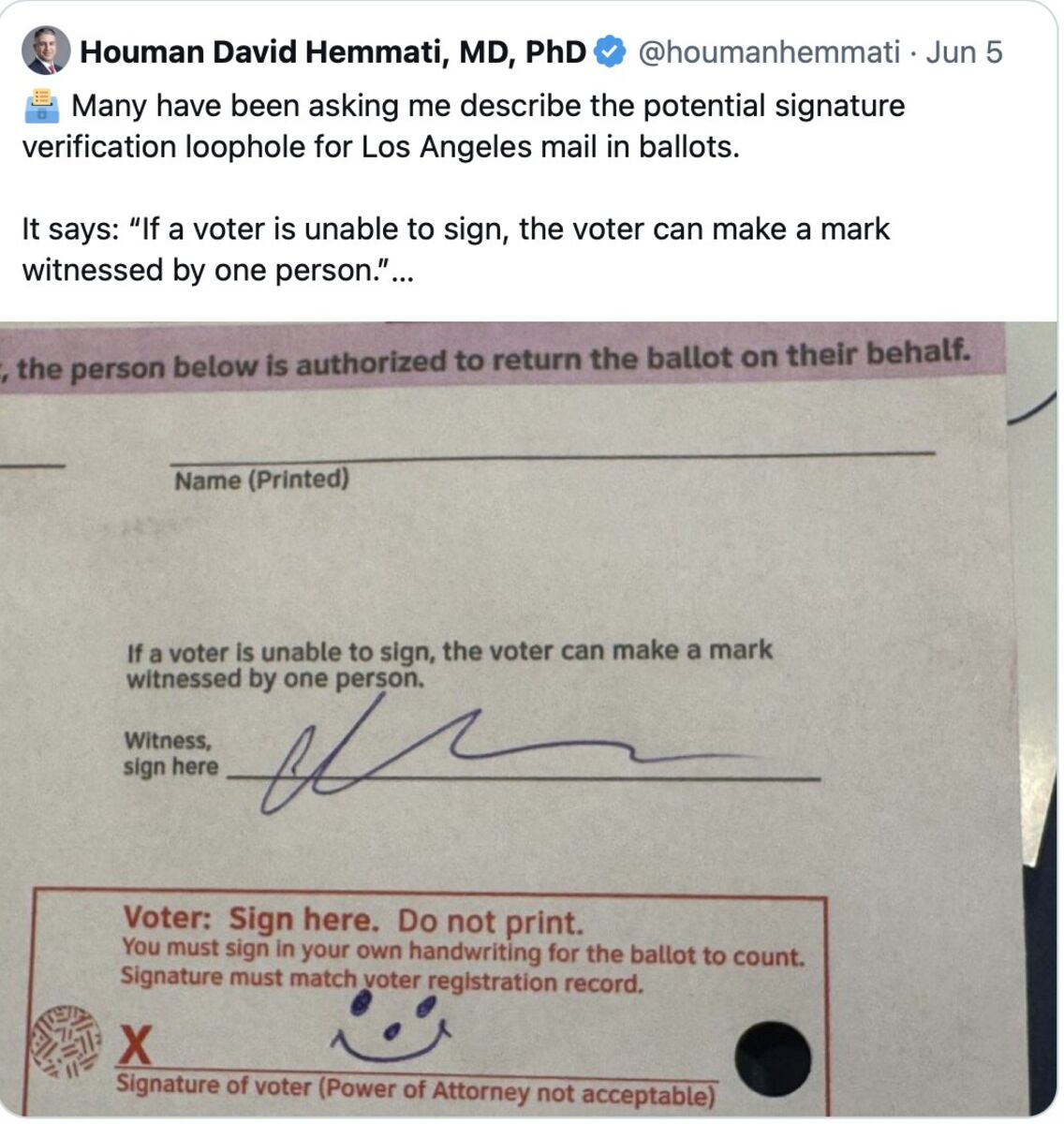
"Smiley face signature" on a ballot has gone viral since Houman Hemmati posted it.
This isn't speculation about isolated fraud. It's the predictable outcome of a system that combines no-ID mail-in voting, ultra-lenient signature verification, centralized ballot mailing to homeless hubs, and a court ruling that protects the right to vote while leaving the door wide open to industrial-scale harvesting.
Angelenos deserve answers. The public has a right to know exactly where those late DTLA drops originated, how many "marked" ballots were accepted, and whether any of them were collected or influenced for cash. Until those questions are answered with full transparency, the final tallies in this race will remain under a very dark cloud.




Reader Comments(0)