
Community, Diversity, Sustainability and other Overused Words


Community, Diversity, Sustainability and other Overused Words
New construction has collapsed on the order of 75 percent over five years through 2025, with further declines into 2026.
China's graffiti towers are the result of the Chinese RE crisis, as the chinese developer went bankrupt.
Peter Zeihan explains the Chinese RE collapse.
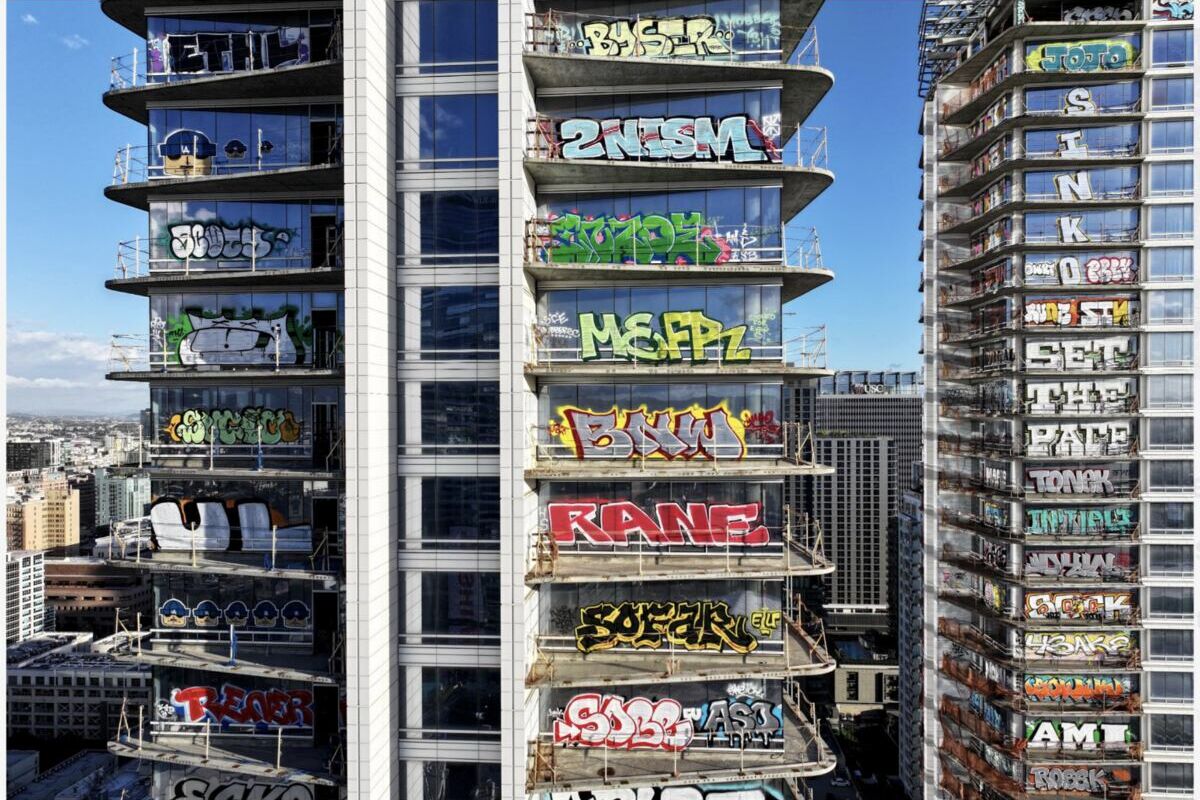
Across from Crypto.com Arena, three unfinished towers still wear the spray paint that made them famous. Oceanwide Plaza was supposed to be a luxury hotel, condos, and retail podium - Beijing capital planted in the middle of downtown Los Angeles. Instead it became a $1.2 billion steel skeleton, stalled at about 60 percent complete after 2019, tagged across dozens of floors in 2024, then forced into bankruptcy. A local-Australian joint venture is now trying to buy it out for roughly half a billion dollars and spend hundreds of millions more to finish what China started.
The graffiti is not just vandalism. It is the American face of a Chinese property machine that ran out of money at home and, for a time, ran out of permission to spend abroad.
The sentence that explains the towers
In August 2026, a Shenzhen court sentenced Evergrande founder Hui Ka Yan to life in prison, confiscated his assets, and fined the company group more than $2 billion. Evergrande's collapse left on the order of $300 billion in liabilities. Geopolitical analyst Peter Zeihan's blunt reading of that verdict is the right starting point: this is what happens when you do exactly what the Chinese state told you to do, and the model fails.
Peter Zeihan explains the Chinese RE collapse.
For two decades the model was simple. Chinese households had almost nowhere productive to put savings. Outbound investment was tightly restricted because Beijing understood its own system offered poor real returns; open the gates and capital would leave in the trillions. At home, firms were financed for throughput and jobs, not profit. They borrowed at subsidized, often negative real rates. An equity investor in those companies was buying a claim on an entity that did not need to generate a market return.
Local governments filled the gap. Land sales to developers became more than half of many localities' revenue. Developers pre-sold apartments to households. Urbanization and the industrialization pulse made the loop look endless: prices up, more towers, more land sales, more deposits recycled into more concrete.
Two facts killed it. First, China built far more housing than it needed - by some measures four or five times too much. Second, the buyers stopped being born. Official statistics now show the Chinese birth rate fell below the American rate in the early 1990s. A 35-year baby drought eventually shows up as empty inventory.
New construction has collapsed on the order of 75 percent over five years through 2025, with further declines into 2026. Independent and BIS-based measures put real home prices back at or below mid-2000s levels - the comparison Zeihan draws to the U.S. after 2007–09, except stretched over two decades of lost appreciation. Households who prepaid for unfinished units, or who treated a second apartment as a pension, took the loss. The stock market did not absorb the shock the way a Western market might: Beijing manages the tape, and ordinary Chinese already treat A-shares as a mug's game for the same reason they treat corporate equity as a mug's game. Subsidized credit means the shareholder is last in line.
The leftover cash is enormous. Household deposits reached the mid-twenty-trillion-dollar range by late 2025. The state has pushed deposit rates toward and below 1 percent and tried to herd that money into equities. Households have mostly refused. The only other destination that makes sense to them is out.
That is the line Zeihan ends on, and it is the line that connects Shenzhen courtrooms to Figueroa Street: foreigners still talk about getting money into China. People inside China are looking for any pipe that gets money out.
Two kinds of Chinese money, two kinds of California
Oceanwide Plaza is the first kind: official-era corporate capital. Beijing-based Oceanwide Holdings bought the downtown lot in 2014, broke ground in 2015, and aimed to finish by 2019. Then Beijing slammed the door on "irrational" outbound deals - real estate, hotels, entertainment - after the 2016 binge by firms like Anbang, HNA, Wanda, and Oceanwide itself. Construction stopped when the parent could no longer fund the U.S. subsidiary. EB-5 visa investors were in the capital stack. The project sat. Taggers and base jumpers arrived. The city spent millions just to secure an eyesore across from the arena.
That is not a story of Chinese money inflating Los Angeles in 2026. It is a story of Chinese money stranding Los Angeles - a trophy from the last cycle that Beijing later treated as capital flight in corporate clothing.
The second kind is quieter and still moving: household and gray-market capital looking for a hard asset in dollars.
Chinese buyers remain among the largest foreign purchasers of U.S. homes by dollar volume. In the April 2024–March 2025 window they spent $13.7 billion and were the top foreign group by value, with California taking about 36 percent of those purchases and an average price near $1.2 million; a large majority paid cash. In the following year, unit volume fell and China slipped in count rankings, but Chinese buyers still led foreign spending at $7.6 billion, with average prices around $1 million and California still the preferred state (about 38 percent in the latest NAR cut). Foreign buyers as a whole are only about 2 percent of U.S. existing-home dollar volume. That is not enough to create a national bubble by itself. It is enough to matter at the margin in specific California ZIP codes where inventory is thin, schools and visa networks cluster, and sellers learn that a cash bid from a foreign buyer does not blink at list.
Legal channels cannot carry that scale. The individual forex facilitation quota is still about $50,000 a year, and Beijing has been explicit that it is not an overseas-property allowance. In 2026, State Council Order No. 837 pulled individuals into the outbound-investment rulebook. The honest official path is narrow. The unofficial paths are not.
The thesis: crypto is the pipe that still works
Underground banks - dixia qianzhuang - have moved Chinese savings into foreign property for years. FinCEN's own analysis of suspicious-activity reports describes the pattern: stacked inbound transfers, rapid consolidation, then a U.S. real-estate purchase, often involving students or relatives as nominees. Trade misinvoicing and casino junket credit did the same job for a different clientele. Those rails still exist. Beijing keeps announcing crackdowns because the demand to leave has not gone away.
Crypto, and especially dollar stablecoins, is the rail that scales without a suitcase of cash.
USDT and USDC are already the working dollar for much of offshore Asia. The People's Bank of China has said the quiet part out loud: stablecoins are treated as illegal virtual currency in part because they are used for "illegal cross-border capital transfers." That is not Western conspiracy language. It is the central bank describing the product-market fit. On Chinese social media, luxury Shenzhen apartments are now priced against Bitcoin and BNB. The comparison only makes sense if property at home is no longer trusted as a store of value and a token that can clear in minutes is.
The conversion sequence is not mysterious:
RMB leaves the regulated banking system through an OTC desk, an underground banker, or a stacked family quota.
It becomes USDT or USDC - a dollar that does not need a SAFE approval code.
The token moves to a Hong Kong, Singapore, Dubai, or U.S.-facing venue.
It is cashed into a U.S. account, a title-company wire, or, increasingly, a crypto-settled real-estate close.
The asset on the other end is a California house, not a Shenzhen pre-sale.
That last step is why California keeps showing up in NAR tables. The state is close in time zone, dense with existing Chinese networks, and short of houses. A cash buyer who already paid a risk premium to get capital out is not shopping for cap rate. They are shopping for a title that Beijing cannot freeze with a phone call.
Does that "inflate our RE into a bubble"? Nationally, no - not by itself. U.S. prices are a function of rates, zoning, household formation, and a decade of underbuilding. Foreign Chinese purchases are a sliver of that market. Locally, in the Bay Area, the Westside, Irvine, and a handful of other nodes, a persistent stream of high-price cash bids does what cash bids always do: it sets the comp. Chinese institutional commercial buying actually collapsed after the 2016–17 controls; households and gray capital filled a different niche. The graffiti towers are the tombstone of the old corporate wave. The single-family bid is the new one.
The symmetry Zeihan keeps pointing at
China overbuilt housing for a population that stopped replacing itself, financed the overbuild with land sales and household prepayments, then punished the developer who ran the model at industrial scale. It trapped the leftover savings in banks paying almost nothing, locked the exits, and is now surprised that people invent new exits.
The United States, meanwhile, still treats inbound cash as a closing problem rather than a capital-flow problem. Title companies take wires. Some platforms now take stablecoins. The same dollar token that Beijing calls a capital-flight tool is, on this side of the Pacific, just another way to fund escrow.
Oceanwide Plaza will probably get washed and finished for the Olympics cycle. The tags will come off the glass. That will not mean the underlying trade is over. It will mean the last monument of the corporate outbound boom has been absorbed by local capital, while the household outbound boom keeps arriving one deed at a time - through banks when it can, through crypto when it cannot.
The people who want into China and the people who want out of China are not looking at the same country. The graffiti towers were built by the first group. California's bid stack is being fed by the second.


Reader Comments(0)