
Community, Diversity, Sustainability and other Overused Words


Community, Diversity, Sustainability and other Overused Words
His 1978 transformation of a modest 1920s pink Dutch Colonial bungalow at 22nd Street and Washington Avenue-now a pilgrimage site for architecture enthusiasts-ignited controversy among neighbors
Frank Gehry, Architect who designed the Disney Concert Hall in Downtown LA, and many other well known buildings.
His 1978 transformation of a modest 1920s pink Dutch Colonial bungalow at 22nd Street and Washington Avenue-now a pilgrimage site for architecture enthusiasts-ignited controversy among neighbors.
Santa Monica, Calif. - Frank O. Gehry, the visionary architect whose deconstructed bungalow on a quiet Santa Monica corner in the 1970s foreshadowed a career of audacious, curve-defying masterpieces that reshaped skylines from Bilbao to downtown Los Angeles, died on Dec. 5, 2025, at his home here. He was 96.
The cause was a brief respiratory illness, according to Meaghan Lloyd, chief of staff at Gehry Partners, the firm he founded in 1962 and led from offices overlooking the Pacific just blocks from his residence.
To Santa Monicans, Gehry was more than a starchitect; he was a local provocateur and enduring fixture, the man who turned chain-link fences and corrugated steel into high art while living among them. His 1978 transformation of a modest 1920s pink Dutch Colonial bungalow at 22nd Street and Washington Avenue-now a pilgrimage site for architecture enthusiasts-ignited controversy among neighbors who decried its "unfinished" look of exposed plywood, tilting glass walls, and industrial fencing. Yet it became a harbinger of deconstructivism, blending raw urban grit with domestic intimacy and offering canyon views that captured the essence of Santa Monica's bohemian spirit. From that unassuming canvas, Gehry launched a revolution, proving that the beachside enclave could birth global icons.
Born Frank Owen Goldberg on Feb. 28, 1929, in Toronto to Polish Jewish immigrants Irving and Sadie (Caplan) Goldberg, young Frank spent childhood hours in his grandfather's hardware store, fashioning fantastical cities from scraps of wood and wire-a tactile prelude to his later forms. The family fled antisemitism in the mid-1940s, relocating to Los Angeles, where his father anglicized their surname to Gehry. A restless teen, Frank drove a delivery truck while sampling classes at Los Angeles City College, eventually earning a bachelor's in architecture from the University of Southern California in 1954.
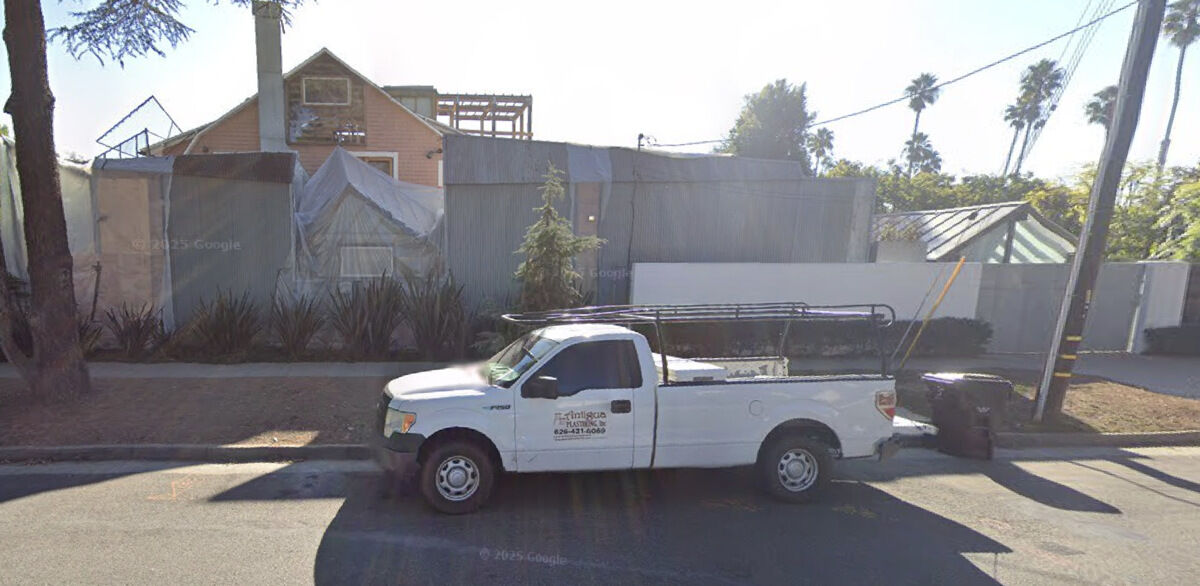
His 1978 transformation of a modest 1920s pink Dutch Colonial bungalow at 22nd Street and Washington Avenue-now a pilgrimage site for architecture enthusiasts-ignited controversy among neighbors.
After U.S. Army service and a stint at Harvard studying urban planning, Gehry returned to L.A., apprenticing under modernists like Victor Gruen. But conformity chafed; in 1962, he hung his shingle in a Santa Monica bungalow, embracing the area's countercultural vibe. Early works, like the 1979 Easy Edges furniture line of layered cardboard, echoed the DIY ethos of Venice Beach. His breakthrough came at home: The Gehry Residence, renovated on a shoestring with his first wife, Anita Snyder, exposed the building's skeleton and wrapped it in everyday materials, symbolizing a rejection of sterile modernism. "It was like exploding a house," he later said, a sentiment that resonated in Santa Monica's evolving mosaic of artists and surfers.
Gehry's second marriage in 1975 to Berta Isabel Aguilera, a Panamanian he met in Los Angeles, brought stability and two sons, Alejandro and Sam, who later joined the firm. (From his first marriage, he had daughters Leslie and Brina.) The couple raised their family in that iconic Santa Monica house until 2012, when they moved to a newer Gehry-designed timber-and-glass retreat nearby, still within earshot of the waves. Throughout, Santa Monica grounded him; he skated its boardwalk, rooted for the Kings at local rinks (a nod to his Canadian youth), and infused his designs with the city's fluid, sun-drenched optimism.
Global acclaim followed. The 1989 Pritzker Architecture Prize hailed him as architecture's Nobel laureate. His titanium-sheathed Guggenheim Museum Bilbao (1997) not only revived a rusting Spanish port but coined the "Bilbao Effect," drawing a million visitors in its first year and proving bold design could turbocharge economies. Back home, the Walt Disney Concert Hall (2003)-its stainless-steel sails shimmering like sails on the bay-transformed L.A.'s civic heart, with Gehry sketching curves inspired by Santa Monica's windswept dunes. Other triumphs included the undulating Fondation Louis Vuitton in Paris (2014), the crystalline New World Center in Miami (2011), and the serpentine Jay Pritzker Pavilion in Chicago (2004).
A pioneer of computer-aided design-adapting Boeing software for his labyrinthine forms-Gehry democratized complexity, making the improbable buildable. Yet he remained a Santa Monica everyman: an ice hockey evangelist who founded the office league FOG (Frank Owen Gehry) and played into his 80s; a reluctant celebrity who quipped, "At least they're looking!" about critics of his gleaming Disney Hall.
Even in his final years, Gehry was sketching: a LEED Platinum mixed-use tower at Ocean Avenue and Santa Monica Boulevard, weaving hotel, housing, and a Gehry archive museum into the city's fabric, with $50 million in community benefits for arts and affordability. At his death, projects loomed in Beverly Hills and Paris for LVMH's Bernard Arnault, a longtime patron.
Tributes poured in from Santa Monica's shores to global capitals. Mayor Gleam Davis called him "the soul of our skyline," crediting his designs for elevating the city's cultural pulse. Canadian Prime Minister Mark Carney, honoring Gehry's restored citizenship in 2002, said his "unmistakable vision lives on in iconic buildings around the world." Paul Goldberger, Gehry's biographer, noted: "He worked until the day he died, exploding conventions like he did that bungalow-proving architecture could be joyous, human, hopeful."
Gehry is survived by his wife, Berta; daughters Leslie Gehry Brenner and Brina Gehry; sons Alejandro and Sam; five grandchildren; and a legacy etched in titanium and timber, forever bending the horizon. In Santa Monica, where it all began, his houses stand as quiet sentinels: reminders that from a corner lot, one can redraw the world.




Reader Comments(0)