
Community, Diversity, Sustainability and other Overused Words


Community, Diversity, Sustainability and other Overused Words
Traci Park shared photos and updates on social media, noting that county engineers identified the material as a protective cement layer from the 1970s that had deteriorated over time
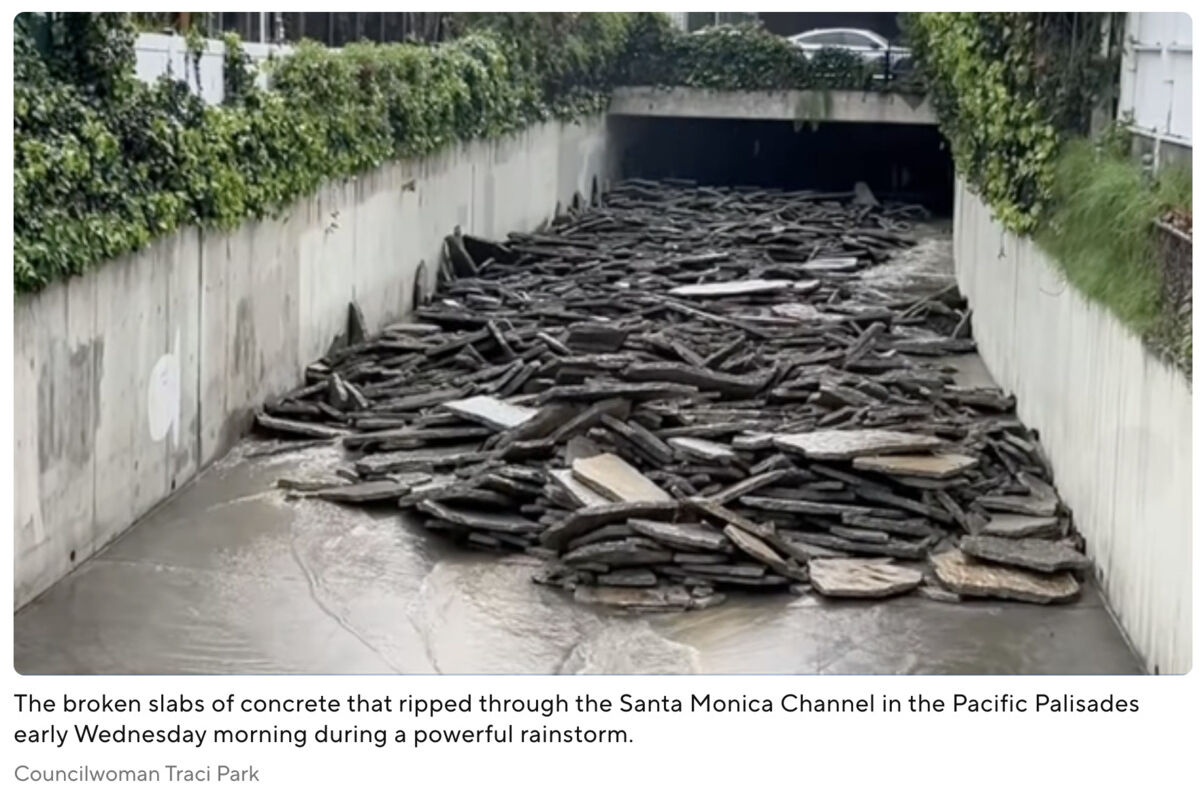
Sacrificial Concrete Fills Storm Drain from Councilwoman Traci Parks
A series of intense back-to-back winter storms battered Southern California this week, unleashing powerful rushing waters through the Santa Monica Channel and dislodging dozens of large concrete slabs from its aging walls. The massive blocks—part of a sacrificial concrete overlay installed in the 1970s—peeled away and were carried downstream, piling up dramatically in sections near Pacific Palisades and the confluence with Rustic Canyon. Residents living adjacent to the channel described hearing sounds like a freight train roaring through, accompanied by noticeable ground vibrations as the forceful currents tore loose chunks of the nearly 50-year-old infrastructure.
The storms delivered substantial rainfall across the region, with areas including Santa Monica accumulating over 2 inches in recent days, exacerbating erosion and contributing to the displacement of the concrete material. LA County Public Works field engineers confirmed that the dislodged slabs have reduced channel capacity by approximately 15% near the Rustic Canyon confluence, though the structure remains capable of handling projected storm flows. Cleanup operations have been postponed until the current weather system fully passes to ensure worker safety and prevent further complications.
Los Angeles City Councilwoman Traci Park shared photos and updates on social media, noting that county engineers identified the material as a protective cement layer from the 1970s that had deteriorated over time. Officials emphasized that the channel continues to be closely monitored amid ongoing rain threats.
While no immediate safety threats to nearby communities or structures have been reported, the incident has drawn attention to the vulnerabilities of older flood control systems during extreme weather events. The Santa Monica Channel, originally lined with concrete following major floods in the 1930s, serves as a critical drainage pathway for runoff from the Santa Monica Mountains and canyon areas.
Local authorities and residents remain on alert as the third and final storm in this series is forecast to bring an additional 0.25 to 1 inch of rain through Thursday, potentially testing the channel's reduced capacity further. The event underscores broader regional concerns about infrastructure resilience, storm preparedness, and the impacts of increasingly intense atmospheric river systems on coastal and foothill communities in Los Angeles County.
WHAT IS SACRIFICIAL CONCRETE?
In the context of the Santa Monica Channel incident, "sacrificial concrete" (also called a sacrificial concrete overlay or invert overlay) refers to an additional protective layer of concrete intentionally installed on the bottom (invert) or sometimes sides of a flood control channel. This layer is designed to wear away, erode, or be damaged over time instead of the main structural concrete beneath it.
The Santa Monica Channel, like many in Los Angeles County, was originally lined with concrete in the 1930s and later decades to prevent erosion and contain floodwaters after major historical floods. In the 1970s, engineers added this extra "sacrificial" overlay specifically to shield the primary channel lining from abrasion and scouring caused by fast-moving, sediment-laden stormwater flows during heavy rains. The overlay acts as a replaceable barrier—sacrificing itself to absorb the wear from high-velocity water, gravel, and debris—so the underlying structural concrete (the channel's core walls and floor) remains intact and the overall flood control system stays functional longer.
During the recent February 2026 storms, powerful rushing water dislodged dozens of these large, deteriorated slabs from the 1970s overlay, carrying them downstream and piling them up near areas like Rustic Canyon. LA County Public Works engineers described it as a "sacrificial concrete overlay" that peeled off due to age and extreme flows, reducing channel capacity by about 15% in spots but not threatening the main structure or nearby safety. Cleanup is delayed until storms pass, as the overlay fulfilled its protective role by taking the damage rather than allowing deeper erosion into the channel's essential infrastructure. This design approach is common in flood control engineering to extend the service life of aging concrete channels without frequent full reconstructions.


Reader Comments(0)