
Community, Diversity, Sustainability and other Overused Words


Community, Diversity, Sustainability and other Overused Words
Even patient California voters are starting to question how exactly California Democrats can be so bad at delivering.
Artists concept of a railroad on the moon
NASA's artist concept of America's moonbase
Update: The California High-Speed Rail Authority disputes the veracity of the headline to this article. E-mail from their spokesman is included below, at bottom of the page.
Washington, D.C. - NASA announced an ambitious plan Tuesday to construct a permanent moonbase near the lunar south pole for approximately $20 billion over the next seven years, a figure that highlights stark contrasts in public-sector project efficiency when compared to longstanding infrastructure challenges on Earth.
The plan, outlined by NASA Administrator Jared Isaacman, calls for building habitats, pressurized rovers, and nuclear power systems through dozens of missions in partnership with commercial companies and international allies. The $20 billion investment covers the initial phases focused on sustained human presence on the Moon, with potential additional funding extending the effort further.
"This moonbase will not appear overnight," Isaacman said. "We will invest approximately $20 billion over the next seven years and build it through dozens of missions, working together with commercial and international partners towards a deliberate and achievable plan."
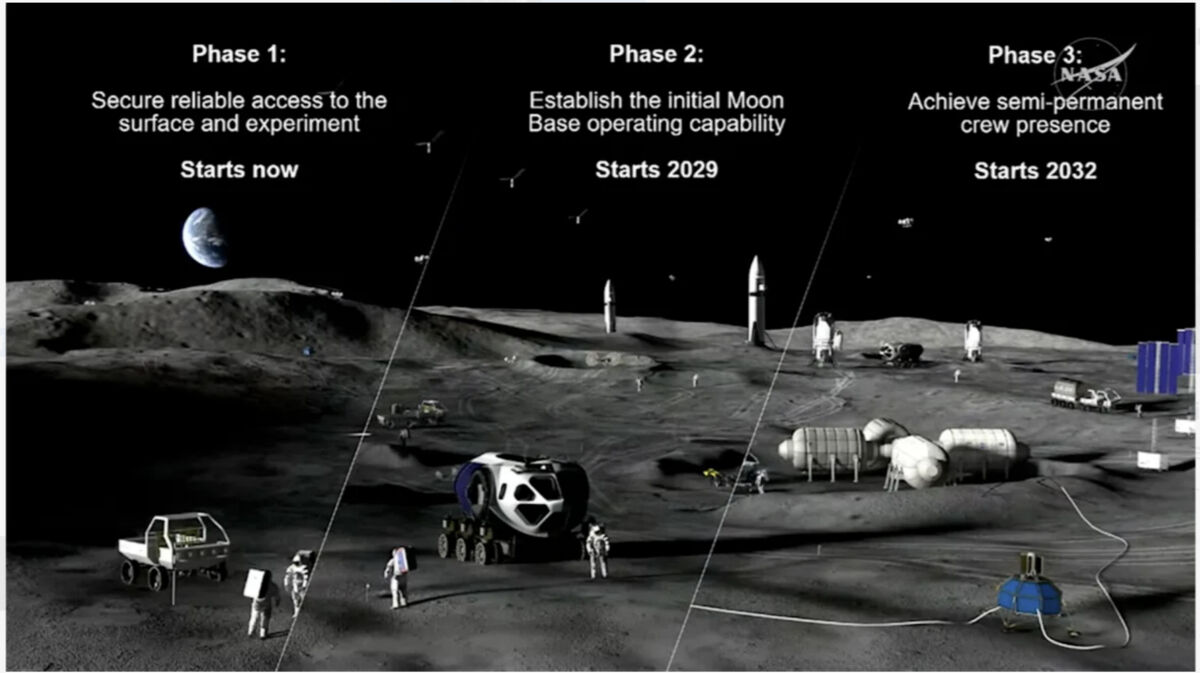
NASA's artist concept of America's moonbase
The announcement comes amid broader Artemis program efforts, with NASA shifting priorities away from a lunar orbital station (Gateway) to prioritize surface infrastructure.
For context on the scale of such spending, the $20 billion moonbase budget represents roughly 15% of the amount California has spent to construct just 1,600 feet of elevated rail viaduct as part of its long-troubled high-speed rail project-without any tracks laid on that section.
The viral comparison, first highlighted in a 2024 presentation by Palantir CTO Shyam Sankar, drew attention to the gap between private-sector space achievements and certain government infrastructure efforts. Sankar contrasted SpaceX's roughly $10 billion investment to launch more than 300 rockets into orbit with California's reported $11 billion expenditure on limited high-speed rail progress, including the Fresno River Viaduct area.
Fact-checks have clarified that the $11 billion figure reflects broader program spending over many years (from 2006 onward), not solely the 1,600-foot viaduct itself, which is one small completed element within a much larger package of Central Valley construction contracts totaling around $2 billion for multiple structures.
California's high-speed rail project, voter-approved in 2008 with an original $33 billion estimate for a San Francisco-to-Los Angeles line by 2020, has faced repeated delays and cost escalations. The latest 2026 draft business plan from the California High-Speed Rail Authority projects the initial 171-mile Merced-to-Bakersfield "Initial Operating Segment" at about $34.76 billion (after recent savings efforts), with the full Phase 1 corridor now estimated in the $126 billion range at a P65 contingency level. Cumulative spending has already reached billions, with revenue service for the Central Valley segment now targeted for around 2032–2033.
Critics have long pointed to these figures as emblematic of bureaucratic inefficiencies, regulatory hurdles, and limited competition in traditional government contracting-issues Sankar and others have suggested could be addressed by adopting more fixed-price, results-oriented models common in the commercial space sector.
NASA's moonbase plan, by contrast, leans heavily on commercial partnerships, a strategy that has driven down costs in recent years for programs like crewed lunar landings. While the full Artemis program has already cost tens of billions cumulatively, the new $20 billion moonbase allocation is positioned as a focused, multi-mission effort to establish long-term lunar operations.
Supporters of the NASA initiative argue that space exploration yields technological spin-offs, scientific discovery, and strategic advantages, justifying the investment even as earthly infrastructure projects grapple with overruns. Detractors of the rail project, meanwhile, continue to question why similar levels of funding on the ground have produced far less tangible progress.
As both efforts unfold-one aiming for the stars, the other for high-speed connectivity across California's valleys-the numbers invite ongoing debate about how governments and private innovators can best deliver complex, high-stakes projects on time and on budget.
Update: Dear Santa Monica Observer editors: Kyle Simerly here with California High-Speed Rail.
Thank you for debunking the cost claims of one of our many completed structures in the Central Valley in the body of this piece from yesterday.
But that debunk is not reflected in the headline, which spreads misinformation. Could you please adjust the headline?
The project already has nearly 80 miles of guideway complete, along with nearly 60 fully completed structures, and more than 30 structures underway across Madera, Fresno, Kings and Tulare counties.
The project continues to advance statewide, with 463 miles of the 494-mile San Francisco to Los Angeles/Anaheim system fully environmentally cleared and construction ready. Throughout construction, the project has created nearly 16,700 good-paying construction jobs —most filled by Central Valley residents – and generated nearly $25 billion in economic impact and growth across the state. Up to 1,700 workers report to high-speed rail construction sites each day.
Thank you for your consideration.
Sincerely, Kyle Simerly, Information Officer, Office of Communications and Public Relations, California High-Speed Rail Authority, Sacramento



Reader Comments(0)