
Community, Diversity, Sustainability and other Overused Words


Community, Diversity, Sustainability and other Overused Words
Art, History and the Legionary Life
Dafne Marilù Amalia Nesti (Decima Taurina Caelestis) during a Roman historical reenactment event. What began as curiosity in 2017 eventually became a lifelong passion for Roman history, martial arts, and historical interpretation. Readers interested in Roman historical reenactment can also follow Dafne's ongoing legionary adventures and historical projects through her social media channels.
FOTO 4 Author and illustrator Dafne Marilù Amalia Nesti presents Pliny the Younger – Letters to Tacitus 6.16–6.20, a graphic novel inspired by the only surviving eyewitness account of the eruption of Mount Vesuvius in AD 79. Behind her is one of her original wall paintings, reflecting her passion for combining history, storytelling, and visual art.
Battle (Nîmes Arena): Dafne (Decima Taurina Caelestis) takes part in a battle demonstration during the Roman Games at the Arena of Nîmes, France, one of Europe's largest Roman historical reenactment events.
Testudo (Nîmes Arena) The Roman testudo ("tortoise") formation demonstrated during a historical reenactment inside the Arena of Nîmes, France. Recreating authentic Roman military tactics is one of the central aspects of legionary reenactment.
Dafne Marilù Amalia Nesti is an Italian-born, naturalized American artist whose life took an unexpected turn after returning to Italy following years spent in California. What was originally meant to be a temporary stay slowly evolved into something entirely different: a journey into Roman historical reenactment, martial arts, and independent publishing.
Today, Dafne is not only an artist and author, but also a Roman legionary reenactor known within the reenactment world by her Roman name, Decima Taurina Caelestis. Combining her passion for history and storytelling, she recently created a multilingual graphic novel based on the letters of Pliny the Younger, the only surviving eyewitness account of the eruption of Mount Vesuvius in AD 79.
Roman reenactment is far more than simply wearing historical costumes. Across Europe and beyond, reenactors recreate the daily life of ancient Rome with remarkable dedication. Camps are built far from modern distractions. Participants sleep in tents, cook over open fires, train with ancient weapons, stand guard through the night, and recreate the discipline and routines of Roman military life as authentically as possible.
For Dafne, it all began unexpectedly in 2017.
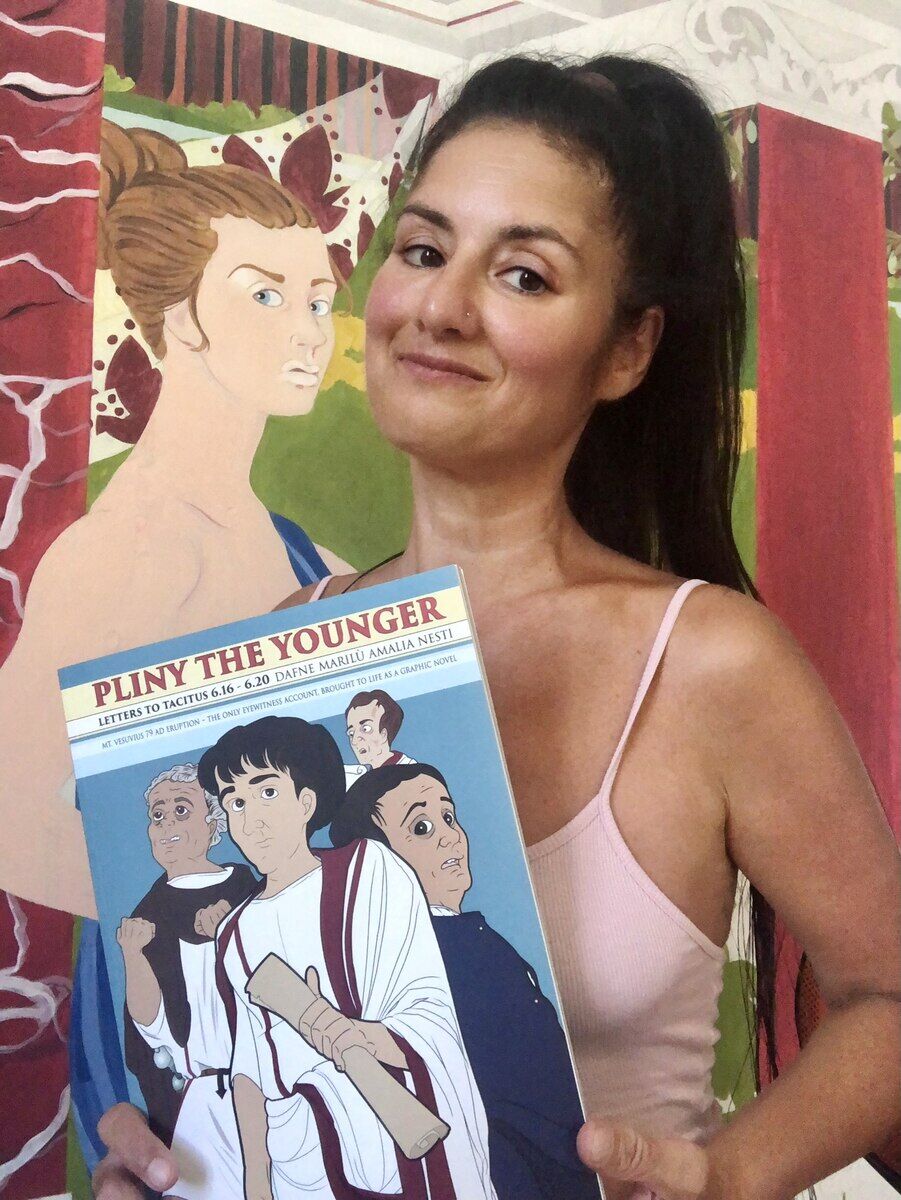
FOTO 4 Author and illustrator Dafne Marilù Amalia Nesti presents Pliny the Younger – Letters to Tacitus 6.16–6.20, a graphic novel inspired by the only surviving eyewitness account of the eruption of Mount Vesuvius in AD 79. Behind her is one of her original wall paintings, reflecting her passion for combining history, storytelling, and visual art.
"At the time, I was preparing to move back to Los Angeles," she explains. "I had saved money, I had a plan, and I thought I would return to California within a year. Then one day I came across an online post about a Roman legionary training course in Rome. Something about it immediately fascinated me."
Living in Milan made participation difficult. Training weekends often meant waking up at 3:30 in the morning and taking a train at dawn to arrive in Rome on time for class.
"It sounds crazy now," she says with a laugh, "but I was completely determined."
What she discovered, however, was far more demanding than she had initially expected.
Historically, Roman legionaries were exclusively male, and entering that environment as a woman was not always easy. Dafne admits that when she first joined, she imagined focusing mostly on the theoretical aspects of reenactment because the idea of combat training intimidated her.
"I had grown up with the idea that weapons and fighting belonged to men," she says. "But the first time I held a gladius and practiced a few strikes, something clicked. It felt strangely natural, as if that side of me had always existed."
Over the years, Dafne trained with three different Roman legions before finally finding her place within her current group, Legio Tertia Consularis, where she eventually earned the role of Decanus of Contubernium II.
The path, however, was not always smooth.
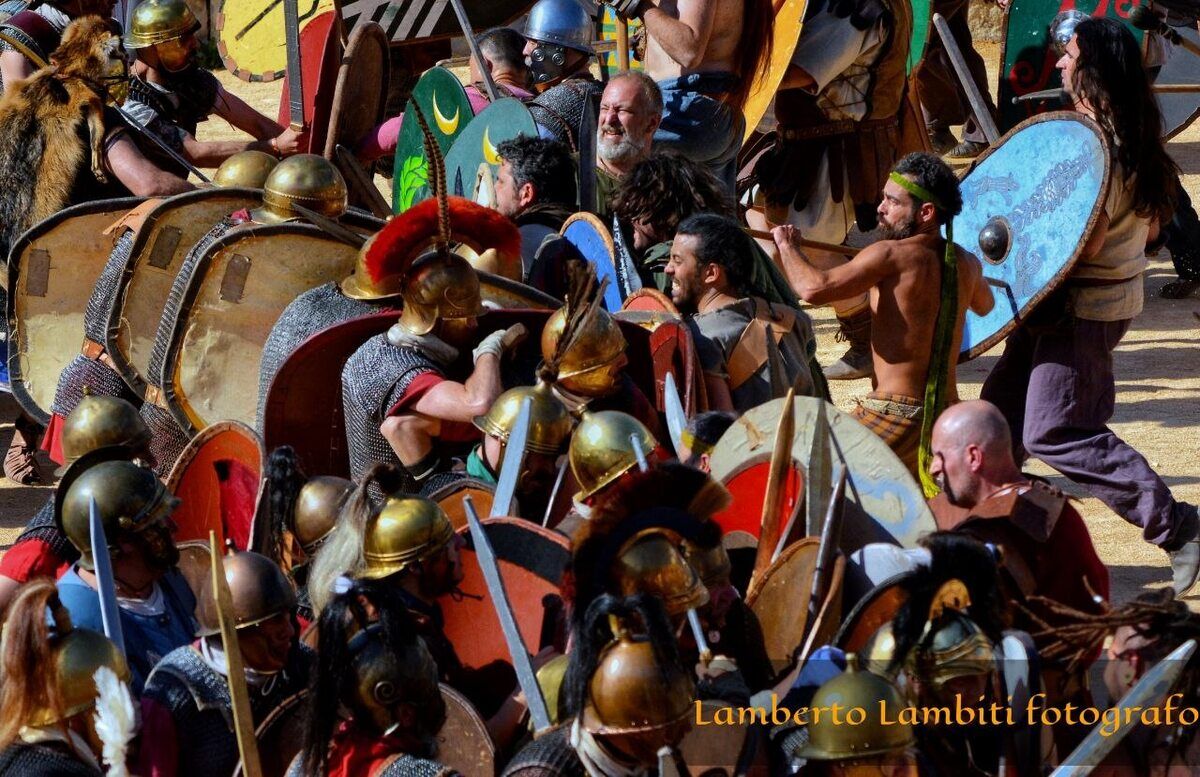
Battle (Nîmes Arena): Dafne (Decima Taurina Caelestis) takes part in a battle demonstration during the Roman Games at the Arena of Nîmes, France, one of Europe's largest Roman historical reenactment events.
"Respect was never simply handed to me," she explains. "I trained like everyone else, but I soon realized I had to work twice as hard to earn the same respect. I stood in the front line, carried equipment, fought in battle, accepted the same responsibilities as the men, and constantly proved that I belonged there. Over time, I earned my place."
That experience deeply transformed her both personally and artistically.
To improve her combat skills, Dafne began studying fencing and martial arts, including Roman and Greek combat techniques, Renaissance fencing, and traditional Southern Italian stick and knife fighting disciplines. Those experiences later inspired the creation of her own illustrated fencing manual.
At the same time, her growing passion for Roman history led her toward a new artistic project: a graphic adaptation of the letters of Pliny the Younger, the Roman writer and eyewitness who left the only surviving firsthand account of the eruption of Mount Vesuvius in AD 79 and the destruction of Pompeii.
"The original Latin texts are extraordinary, but for many modern readers they can feel distant or difficult," she explains. "I wanted to make that story accessible through visual storytelling while remaining faithful to the historical source."
The resulting graphic novel, Pliny the Younger: Letters to Tacitus 6.16–6.20, combines historical narrative with educational content about archaeology, geology, and Roman daily life. The project has now been translated into multiple languages and is printed on recycled paper. It is available online as well as in selected physical locations, including a museum shop in Rome and a souvenir shop in Pompeii. The graphic novel was also recently cataloged by the Pompeii Excavation Public Library and entered into the Italian National Library System, becoming part of the permanent public collection in the city whose story inspired the project.
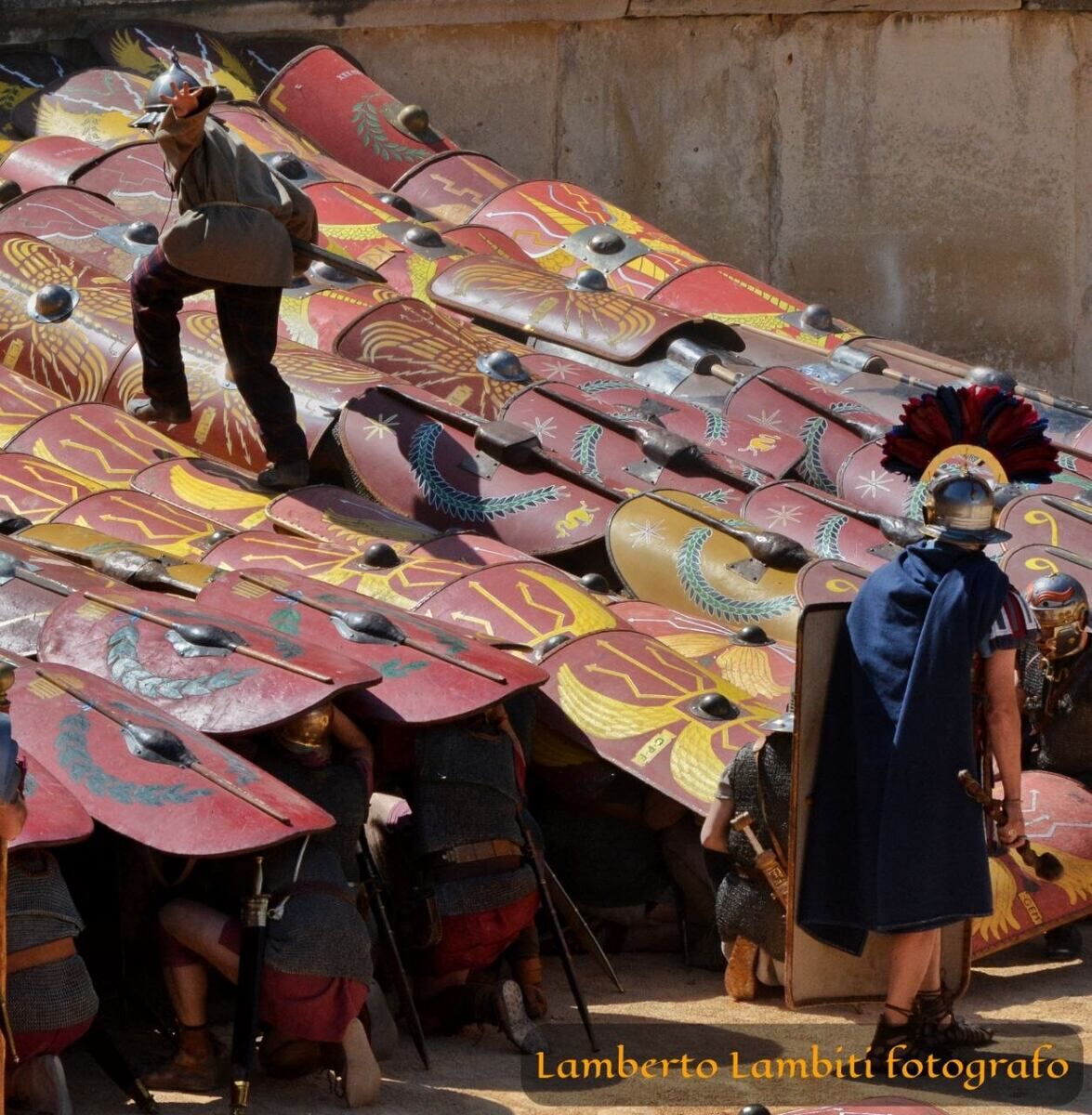
Testudo (Nîmes Arena) The Roman testudo ("tortoise") formation demonstrated during a historical reenactment inside the Arena of Nîmes, France. Recreating authentic Roman military tactics is one of the central aspects of legionary reenactment.
To better serve American readers, copies distributed in the United States are also printed domestically. This reduces shipping costs and transportation while allowing the U.S. edition to be produced using approximately 98% recycled materials.
For Dafne, Pompeii itself remains one of the greatest inspirations behind the project.
"There is something deeply emotional about Pompeii," she says. "Many people who visit feel a strange connection to the site. You are not simply observing ruins-you are walking through interrupted lives."
Like many independent artists, however, building a creative career has not been easy.
"The artistic side is difficult, of course, because every single page requires enormous amounts of work," she explains. "But in Italy, bureaucracy can become equally exhausting for independent creators."
Without becoming overly political, Dafne describes the administrative system as one of the greatest obstacles faced by small artists and self-employed creatives.
"There are moments when it feels like the system discourages initiative rather than supporting it," she says. "Simple processes become unnecessarily complicated, especially for people trying to build something independently."
Despite the challenges, she does not regret the unexpected direction her life took.
"I still miss Los Angeles and hope to return one day," she says. "But reenactment changed me completely. It made me stronger, more disciplined, and more determined. I discovered sides of myself that I never knew existed."
What began as curiosity eventually became a philosophy of life.
"I am not only a legionary during events," she says. "That mentality stays with me all the time-the discipline, the endurance, and the ability to keep moving forward no matter how difficult things become."
Today, Dafne continues to expand her artistic work while developing new historical and fantasy projects, combining illustration, storytelling, historical research, and reenactment into a creative path entirely her own.
To learn more about Dafne's projects, including her graphic novel based on Pliny the Younger's eyewitness account of the eruption of Mount Vesuvius, visit http://www.Dafneduck.com.




Reader Comments(0)