
Community, Diversity, Sustainability and other Overused Words


Community, Diversity, Sustainability and other Overused Words
Civilians Crowd Into Metro Stations as Bomb Shelters While Strikes Kill at Least Several and Spark Fires Across Multiple Regions; Moscow Frames Attack as Response to Ukrainian Strikes on Russian Energy Infrastructure
Civilians Crowd Into Metro Stations as Bomb Shelters While Strikes Kill at Least Several and Spark Fires Across Multiple Regions.
Map of strikes
Russian forces launched a large-scale missile and drone attack across Ukraine overnight into July 30, 2026, striking multiple cities including the capital Kyiv and the western city of Lviv, with confirmed civilian casualties.
Air raid alerts sounded across most of the country as ballistic and cruise missiles, along with drones, targeted urban areas. Explosions were reported in Kyiv starting around 1:18 a.m. local time. Ukrainian officials and emergency services reported fires in several districts of the capital, including Obolon, where the historic Pochaina (formerly Petrivka) book and flea market burned extensively after trade pavilions were hit, and Sviatoshyn, where a garage cooperative and other sites caught fire. One person was killed and at least two injured in Kyiv. Residents took shelter in the metro system as missiles struck the city.
In Kryvyi Rih, President Volodymyr Zelenskyy's hometown, a Russian Iskander-M ballistic missile struck a residential home, killing six people-including two girls aged 5 and 12-and injuring eight others. Rescue teams continued searching rubble there. In Lviv, near the Polish border, missiles damaged at least two apartment buildings, injuring around 15 people, with some residents reported trapped under debris as emergency crews worked through the night. Poland scrambled fighter jets and activated air defenses as a precaution due to the proximity of the strikes. Additional impacts and fires were reported in areas including Dnipro and the Vinnytsia region. Overall death tolls from Ukrainian authorities ranged from at least seven to higher figures as operations continued, with dozens injured across the country.
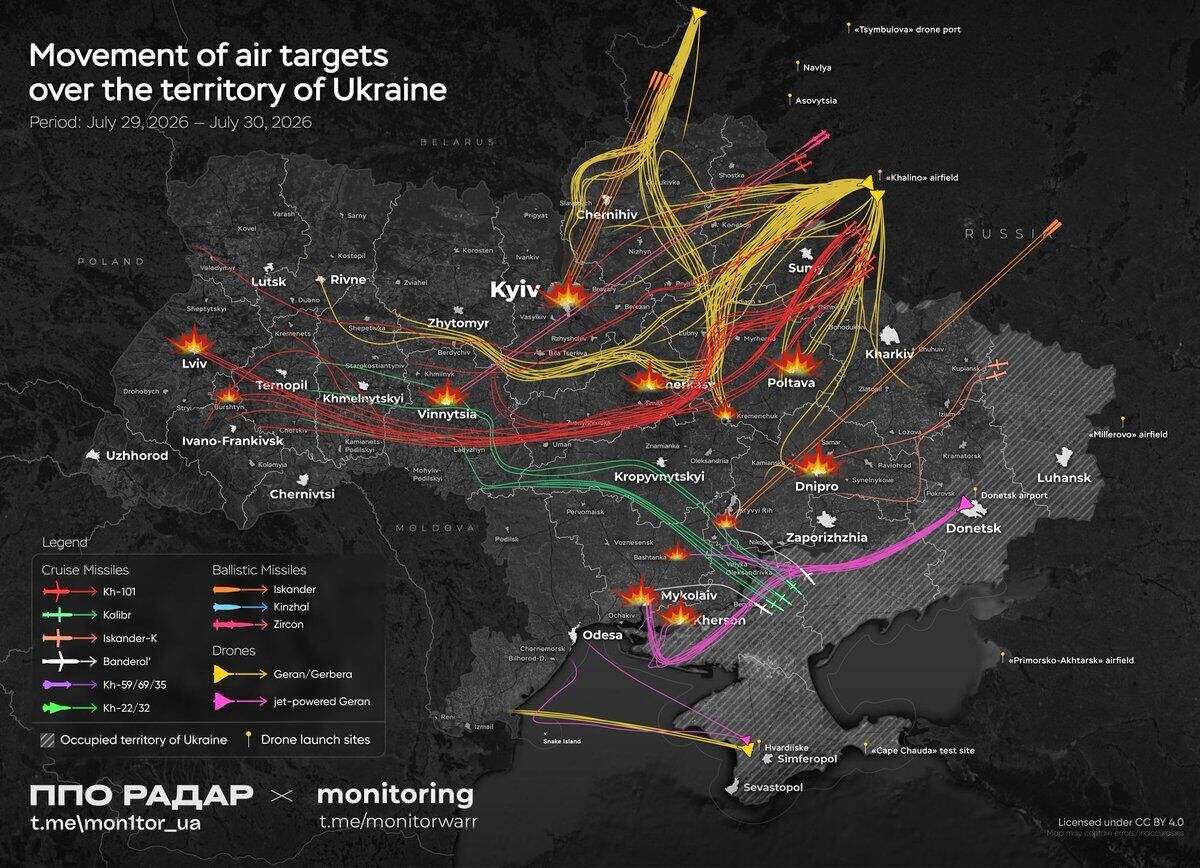
Map of strikes
Zelenskyy had publicly warned the previous day of a high likelihood of a major Russian attack. The strikes occurred as he returned from the United States, where he said U.S. President Donald Trump had agreed to provide licenses related to Patriot air defense systems.
On the question of Russian motives, Moscow has consistently framed such large-scale strikes as responses to Ukrainian long-range attacks on targets inside Russia. In the days immediately preceding this barrage, Ukrainian forces claimed successful drone and missile strikes on major Russian oil refineries, including a Lukoil facility in the Perm region and another in Ryazan, part of an intensified campaign against Russian energy infrastructure that has contributed to reported fuel shortages in parts of Russia.
Russian officials and the Ministry of Defense typically describe their operations as precision strikes against Ukrainian military, defense-industry, and logistics facilities that support Kyiv's war effort, while rejecting characterizations of deliberate civilian targeting. Ukrainian officials, by contrast, describe the attacks as indiscriminate assaults on civilian areas and infrastructure, noting the involvement of ballistic missiles that are harder to intercept and the resulting deaths of non-combatants, including children. Both sides have engaged in reciprocal deep strikes for months, with Ukraine aiming to disrupt Russian logistics, fuel supplies, and military production, and Russia responding with combined missile-drone packages against Ukrainian cities and claimed military sites.
Casualty and damage figures remain provisional as search-and-rescue efforts continue in affected cities. Independent verification of all claimed military versus civilian impacts is ongoing amid the broader conflict that began with Russia's full-scale invasion in 2022.


Reader Comments(0)