
Community, Diversity, Sustainability and other Overused Words


Community, Diversity, Sustainability and other Overused Words
Hundreds of tourists were caught in the path of the flood. Nepal's tourism authorities reported around 384 to over 400 people missing from the affected area
Hundreds of tourists were caught in the path of the flood. Nepal's tourism authorities reported around 384 to over 400 people missing from the affected area
Hundreds of tourists were caught in the path of the flood. Nepal's tourism authorities reported around 384 to over 400 people missing from the affected area
A catastrophic flash flood and mudslide tore through the Himalayan border region between Nepal and China’s Tibet Autonomous Region on Wednesday morning, August 26, 2026, killing at least 390 people and leaving more than 1,400 missing, including large numbers of foreign tourists and pilgrims bound for Mount Kailash.
Nepal Police said hundreds of bodies had been recovered across multiple districts, including Rasuwa, Nuwakot, Dhading, Chitwan, Gorkha, Tanahun and Nawalparasi, with many victims carried far downstream. Chinese state media reported three confirmed deaths and 558 people missing in Gyirong County on the Tibetan side, including 260 foreign nationals. Combined tallies put the death toll near 390 and the number of people unaccounted for at roughly 1,400 to 1,500 as searches continued.
The disaster struck early Wednesday near the Nepal-Tibet border, primarily along the Bhote Koshi and Trishuli river systems. Scientists and officials now say a massive ice avalanche and bedrock collapse high on the north side of Langtang Lirung sent ice, rock and debris crashing into a river valley. The New York Times reported that a chunk of ice about 2,000 feet wide snapped off a glacier from an altitude of around 17,000 feet, dropping nearly 4,000 feet. Later satellite analysis described a glacier-and-bedrock failure at roughly 5,200 meters that plunged about 1,200 meters into the Lhende River, a tributary of the Bhote Koshi. The collapsing ice scraped up moraine, became a high-speed debris flow traveling about 50 meters per second over more than 20 kilometers, and then surged downstream as a wall of water, mud and rock. Surveillance footage from the Gyirong border crossing showed the torrent engulfing buildings, vehicles and people within seconds.
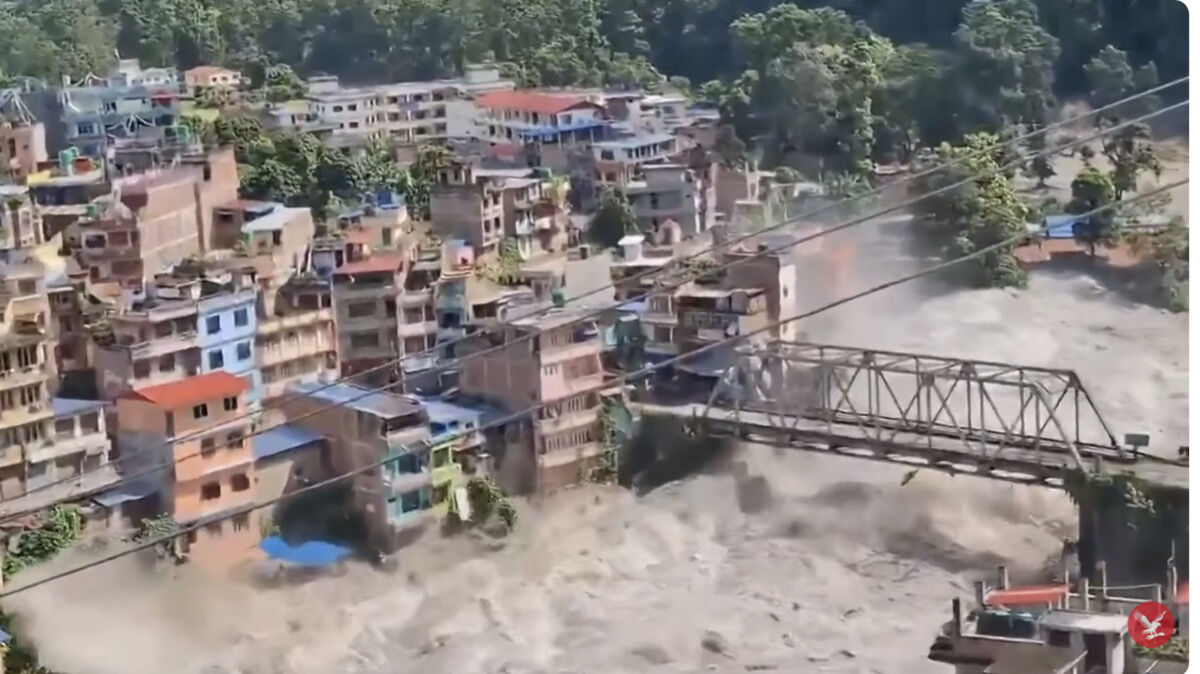
Hundreds of tourists were caught in the path of the flood. Nepal's tourism authorities reported around 384 to over 400 people missing from the affected area
In Nepal, the flood washed away villages, roads, hydropower works and bridges. Officials said dozens of motorable and suspension bridges were destroyed or damaged, including at least 19 driveable spans cited in early damage reports; later assessments put the number of damaged motorable bridges higher. Entire riverside settlements were inundated, and some bodies were recovered as far as 150 kilometers downstream. Dozens of Nepali security personnel were among those initially unaccounted for after posts near the border were swept away.
Hundreds of tourists were caught in the path. Nepal’s tourism authorities said more than 500 foreigners were missing in Nepal alone, among roughly 800 to 900 people unaccounted for on the Nepali side. Early tallies listed about 391 tourists missing; later figures rose as lists were reconciled. Among those unaccounted for were more than 100 Indian nationals, many on the Kailash Mansarovar pilgrimage, as well as Americans, Britons, Australians, Canadians, Malaysians and citizens of more than two dozen other countries. The New York Post initially reported 47 Americans missing; subsequent updates from Nepal’s tourism board and U.S. officials put the number of Americans unaccounted for at about 63 to 90, with at least three U.S. citizens confirmed rescued and no American deaths publicly confirmed. Nepali trekkers, festival-goers and local residents also numbered in the dozens among the missing.
Rescue operations involving the Nepali Army, police and helicopters continued on both sides of the border, complicated by washed-out roads, high water, thick mud and poor weather. Nepal ordered evacuations of vulnerable areas. China mobilized large search teams, and Premier Li Qiang traveled to the border region. India offered humanitarian assistance, and several countries worked to account for their nationals. Authorities also warned that debris had dammed water into barrier lakes, raising the risk of another flood pulse within days.
Officials said the death toll was likely to rise as recovery continued. The disaster ranks among Nepal’s deadliest natural disasters in recent years and has intensified concern about glacial collapse and outburst risks in the warming Himalayas. Search and relief operations remained underway as of Thursday and into Friday.




Reader Comments(0)