
Community, Diversity, Sustainability and other Overused Words


Community, Diversity, Sustainability and other Overused Words
A costly venue choice lets a senator with inverted partisan approval manage three medians at once-Pennsylvania's general electorate, the Democratic primary, and a courted Republican alternative-without abandoning his roll-call coalition.
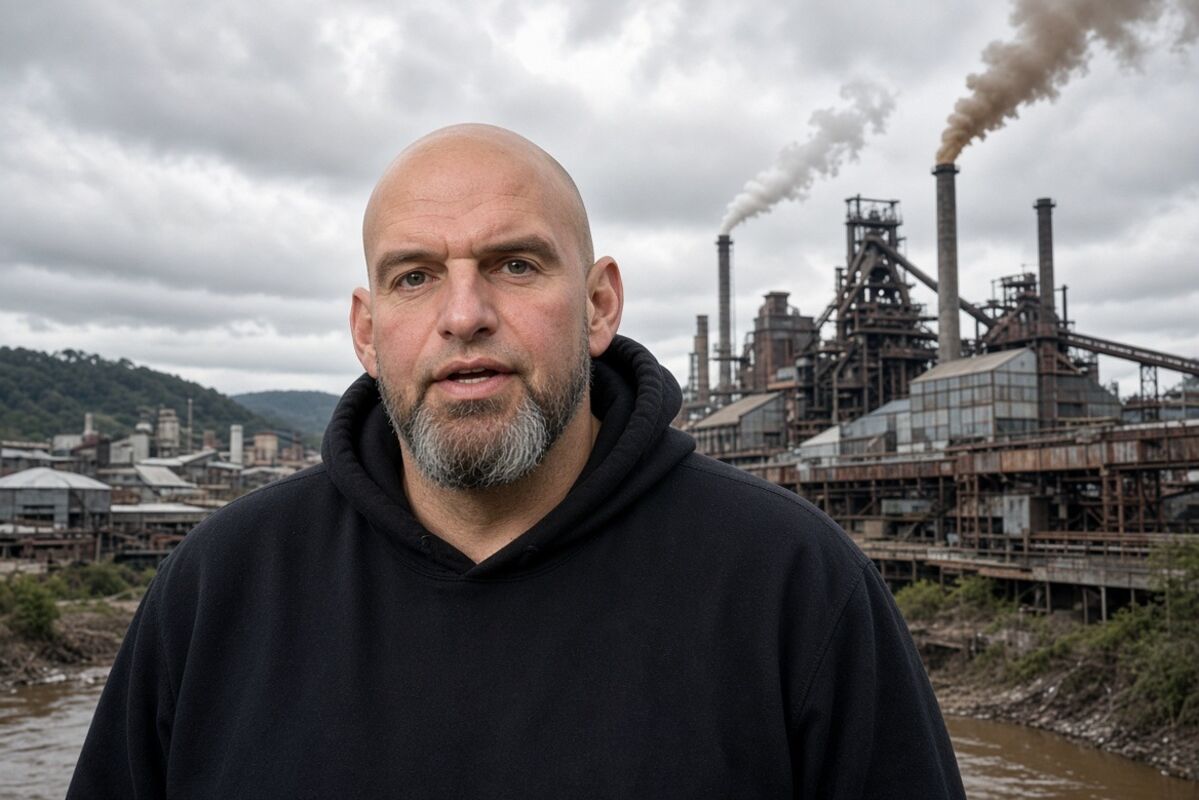
A generated still of the actual format of the appearance: Fetterman on camera from the Steel Valley, not a live speech from the Dallas stage.
PA Sen. John Fetterman's RNC video is best read as a strategic signal in a fragmented two-party system, not as a conversion event. It is an attempt to re-position a senator whose electoral coalition and intra-party standing have diverged.
The incentive structure. Fetterman still votes with Senate Democrats on the large majority of roll calls. That is the cheap talk constraint: switching parties would forfeit committee leverage, the possibility of being the pivotal 51st vote in a narrow Democratic majority, and the formal brand under which he was elected. The expensive signal is the venue and the language. Appearing at an RNC midterm convention to introduce a Republican colleague and to denounce "extremes in socialism" is costly inside the Democratic coalition. Costly signals are useful when an actor needs to persuade a different audience that the cheap talk (party label + 90 percent voting score) no longer fully describes his type.
Intra-party factionalism. Contemporary Democrats contain a growing activist-left faction (DSA-aligned candidates winning primaries) and a residual working-class/industrial faction that Fetterman claims to represent. As the former gains organizational and nomination power, members whose districts or personal brands sit closer to the national median or to specific regional economies face a classic factional squeeze. Fetterman's Pennsylvania base includes steel and energy regions that are not isomorphic with the national Democratic primary electorate. The video is an explicit rejection of the left faction's valence issues while remaining inside the formal party. That is factional differentiation without exit.
Electoral geography and the 2028 problem. Pennsylvania is a large, economically heterogeneous swing state. Fetterman's job approval has inverted relative to 2022–23: relatively strong among Republicans and independents, weak among Democratic identifiers. In a closed or semi-closed primary, that inversion is lethal. The RNC appearance accelerates the selection of a primary challenger and simultaneously keeps a party-switch or independent option in the information set of donors, reporters, and Republican leaders. It is option-value politics. He does not have to exercise the option; he only has to make it credible enough that Democrats cannot take his nomination for granted and Republicans cannot stop courting him.
Dyadic cooperation and "Team PA." The McCormick relationship is not incidental. Senate pairs from the same state have repeated-play incentives on appropriations, earmarks, and industry-specific policy (steel tariffs, infrastructure, energy). A joint fundraising vehicle and public friendship lower the transaction costs of that cooperation. Introducing McCormick at the RNC converts private legislative cooperation into a public valence claim: competence and state interest over national party brand. For McCormick it is a bipartisan endorsement in a midterm environment; for Fetterman it is evidence that he can still deliver for a core constituency even while alienated from his caucus.
Party-system effects. For Republicans the video is a low-cost propaganda good. It supplies visual evidence for the claim that the Democratic Party has moved left of a non-trivial share of its own elected officials. For Democrats it is a coordination problem: punishing Fetterman too hard risks confirming his narrative of intolerance; ignoring him risks further erosion of party discipline and another high-profile defection narrative before November. The midterm calendar compresses that dilemma.
What it is not. It is not evidence that roll-call ideology has flipped. DW-NOMINATE or similar scores will still place him on the Democratic side of the chamber. It is also not a clean "median voter" play in the classic Downsian sense, because the relevant medians are now multiple: the Pennsylvania general-election median, the Democratic primary median, and the national activist median. Fetterman is optimizing across those medians under uncertainty about which selectorate will matter in 2028.
The equilibrium this produces is unstable. If Democrats retake the Senate, his 51st-vote claim gains value and the switch option recedes. If they do not, and if a serious primary challenger materializes, the same video becomes evidence in a different trial: either that he has already left the coalition in all but name, or that he is the last viable vehicle for a non-left Democratic brand in a pivotal state. The RNC appearance simply made that trial harder to postpone.


Reader Comments(0)