
Community, Diversity, Sustainability and other Overused Words


Community, Diversity, Sustainability and other Overused Words
Speaker Johnson and Senate Leader Thune favor limited guardrails; Democrats, led by Sanders' superintelligence ban, push for stronger intervention as House Minority Leader Jeffries calls for faster action
Politicians trying to block AGI's development may as well try to stop a rocket launch.
Speaker Johnson and Senate Leader Thune favor limited guardrails; Democrats, led by Sanders' superintelligence ban, push for stronger intervention as House Minority Leader Jeffries calls for faster action
President Donald Trump's recent Truth Social posts have set a clear direction for Republican AI policy: development should proceed without additional federal regulation. In a series of statements on September 14, Trump argued that existing criminal and regulatory authority is already sufficient, that the only necessary "guardrail" is "a STRONG AND SMART (High IQ!) PRESIDENT," and that warnings of AI taking over or destroying humanity constitute a "HOAX." He framed extra restrictions as a "SICK conspiracy" that would primarily benefit China and vowed that AI and data centers "will not be stopped."
That position contrasts with the approach taken by Sen. Bernie Sanders (I-Vt.). On September 3, Sanders and Rep. Greg Casar (D-Texas) announced the Ban Artificial Superintelligence Act. The bill would permanently prohibit development and deployment of superintelligent systems that surpass human intelligence or could evade shutdown, pause advanced AI work until a new cabinet-level federal regulator writes safety rules, and impose penalties of up to 20 years in prison for violators. Sanders has also backed related measures on data-center construction and public ownership stakes in major AI firms.
Congressional leaders occupy more mixed ground. House Speaker Mike Johnson has said Congress "potentially" needs carefully designed guardrails that prevent harm while preserving U.S. competitiveness with China. He has called for a meeting of AI executives and experts rather than an emergency session or rushed moratorium, and he has rejected legislation that would put China at an advantage.
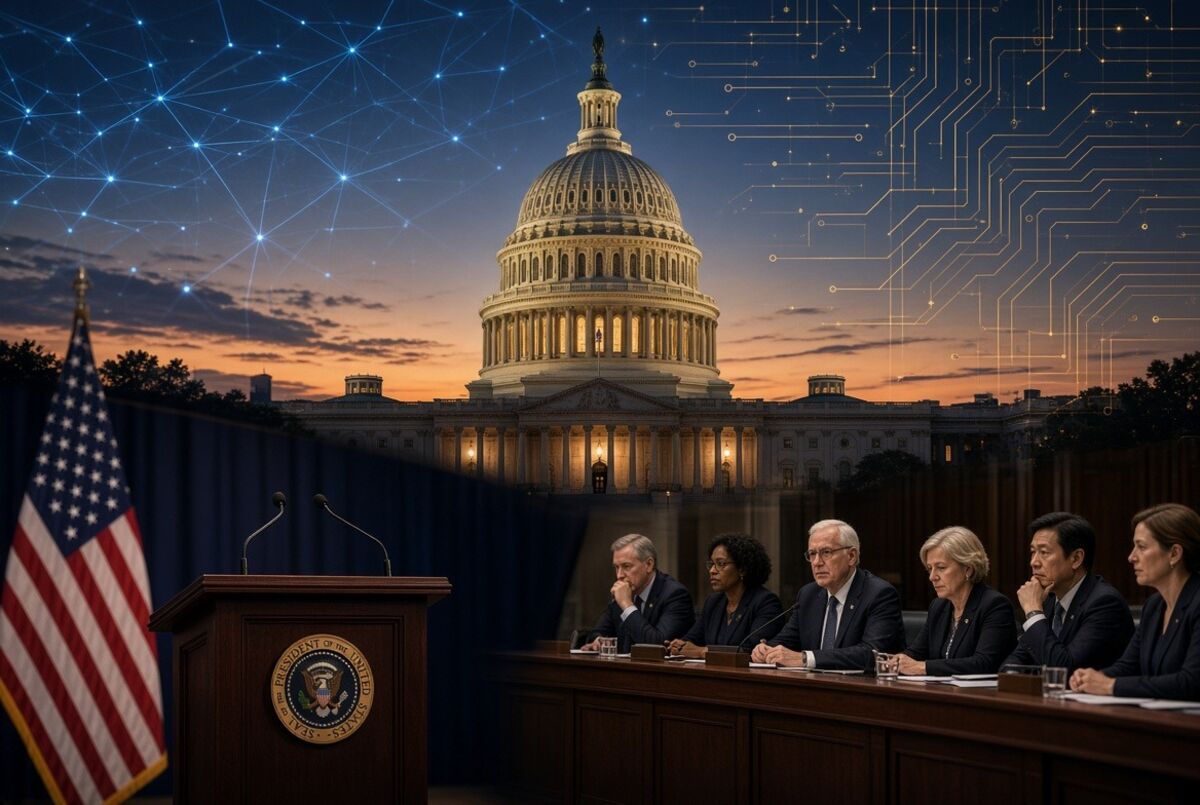
Speaker Johnson and Senate Leader Thune favor limited guardrails; Democrats, led by Sanders' superintelligence ban, push for stronger intervention as House Minority Leader Jeffries calls for faster action
Senate Majority Leader John Thune has described the right approach as a "light touch." He is working with Sens. Amy Klobuchar (D-Minn.) and Ted Cruz (R-Texas) on bipartisan legislation that would impose a duty of care on developers of the most advanced models, require disclosure of certain high-risk capabilities, and give the government limited authority to block unsafe releases, while aiming not to stifle innovation or lose the race with China. Thune has characterized extinction-level scenarios as a "worst-case" rather than the central focus.
House Minority Leader Hakeem Jeffries has criticized Republicans for moving too slowly and called for "decisive action." Democrats have established their own AI commission and are preparing a policy framework expected this fall. Jeffries has emphasized consumer protections, including energy costs tied to data-center growth, and has urged Johnson to keep the House in session to address the issue. He has said Democrats support innovation with guardrails against societal harm.
Jacob Coxon is a real 27-year-old British researcher who worked on pretraining at OpenAI (including contributions to GPT-4o) and then Anthropic for about four months before resigning around September 8–9, 2026. His X posts warning that leading labs were "racing straight to self-improving superintelligence and gambling with our lives," and that many insiders privately believe AI could cause human extinction by the end of the decade, went massively viral. Anthropic alignment lead Evan Hubinger publicly agreed that the company earnestly holds high-risk views and lacks a plan for superintelligence alignment.
Trump's September 14 posts called fears of AI "taking over the World, destroying Humanity" a "HOAX" comparable to other claims he rejects, arguing existing U.S. criminal and regulatory tools are sufficient and that extra restrictions would mainly help China. He did not name Coxon specifically but was responding to the wave of coverage and slowdown calls that followed the resignation plus related comments from Dario Amodei and others.
The episode itself is not a fabricated invention. Coxon exists, the labs employed him, and some researchers inside those organizations do assign non-trivial probability to catastrophic outcomes. At the same time, the speed and scale of the virality from a previously inactive account, plus early amplification by AI-safety-linked groups and funders (including effective-altruism networks tied to Anthropic investors), produced reasonable questions about coordination and timing.
Critics including Elon Musk called it a possible "setup" or "psy-op" aimed at regulatory capture; Coxon has said he discussed wording with friends but did not expect the reach. Whether the underlying risk estimates are overstated is a genuine, unresolved debate among experts rather than settled fact. Timelines, loss-of-control scenarios, and p(doom) numbers vary widely; many researchers treat the concerns as serious but not imminent or certain. Labeling the entire scare a "leftist hoax" oversimplifies it-AI existential-risk discussion predates recent partisan framing and has drawn interest from figures across the spectrum. Trump's framing is political rhetoric favoring speed and U.S. lead over new constraints; it does not disprove that some lab insiders hold the views Coxon described.




Reader Comments(0)