
Community, Diversity, Sustainability and other Overused Words


Community, Diversity, Sustainability and other Overused Words
Partners at the closed shop are waiting to learn whether a transfer materializes. The corner itself is already just another empty retail box on a boulevard that has seen this script before
The green mermaid has packed up again.
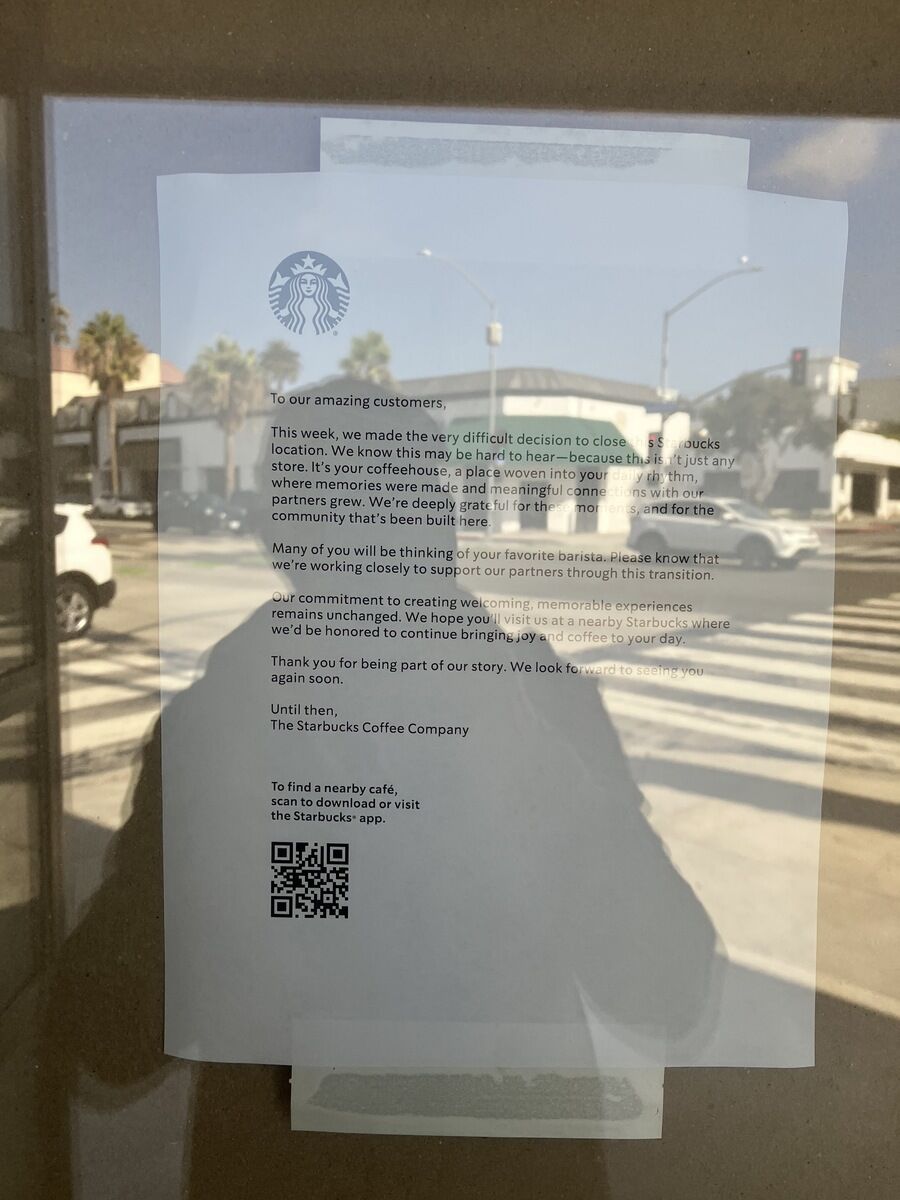
The Starbucks at 1030 Wilshire Boulevard, at 11th Street closed permanently over the weekend, joining a growing list of Santa Monica coffeehouses the Seattle chain has abandoned in the last year. The last cups went out Saturday, September 26, after which the store locator, the app, and the usual weekday line of commuters all went quiet.
The Wilshire shop was not a novelty kiosk. It had seating, a restroom, and years of regulars who treated it as the midpoint between downtown and the residential blocks west of 14th. That did not save it. Starbucks said the location was among about 250 North American stores selected because the company “does not believe it can consistently deliver the experience it wants for customers and partners” or see “a path to acceptable financial performance.” Transfers were offered where possible. Severance was promised where they were not.
The timing is hard to miss. Only days earlier, the Observer reported that the Main Street Starbucks would close Saturday as well. That store, at 2901 Main Street, never had tables, couches, or a bathroom. Store manager Christine told the Observer the company had reached the end of the experiment: current management wants locations with seating. “Perhaps in the future we will return to Main Street,” she said. The announcement echoed earlier Main Street shutdowns, including the 2020 closures after staff described bathrooms and seating areas as unofficial day shelters.
Two stores, two different formats, one weekend. There have been at least four Santa Monica closures in roughly twelve months when it included last September’s shutdowns at 2901 Ocean Park Boulevard and Wilshire near 26th Street. The company still talks about a pipeline of new coffeehouses and a “Back to Starbucks” turnaround. On Wilshire and on Main, the pipeline so far has run in the other direction.
Customers who relied on 11th and Wilshire are being pointed to remaining nearby stores. Partners at the closed shop are waiting to learn whether a transfer materializes. The corner itself is already just another empty retail box on a boulevard that has seen this script before.
The mermaid still has other Santa Monica addresses. How many of those survive the next round of “acceptable financial performance” is a question the company has not answered.The Santa Monica shutdowns at 11th and Wilshire and on Main Street sit inside a much larger accounting event: Starbucks is paying hundreds of millions of dollars to walk away from about 250 North American stores it no longer thinks can earn an acceptable return.
What the company booked
On September 22, 2026, the board approved another round of “Back to Starbucks” portfolio cuts. The September 24 Form 8-K put the expected cost at about $300 million in restructuring charges:
~$200 million cash** — mainly early lease exits and employee separation benefits
~$100 million non-cash** — write-off and impairment of fixtures, equipment, and other store assets
That is about $1.2 million per store if the 250 figure holds. Two-thirds of the hit is real cash leaving the company; one-third is accounting recognition that those cafés’ remaining book value is gone.
Most of the closures, and a large share of the charges, were scheduled to land before fiscal 2026 ended (late September 2026). Starbucks did not publish a store-by-store P&L. The public test was binary: no consistent “coffeehouse experience,” or no “path to acceptable financial performance.”
What it did to growth guidance
The closures also cut the company’s expansion plan:
| Metric | Prior FY2026 guide | After closures |
|---|---|---|
| Net new global company-operated + licensed stores | 600–650 | ~440 |
| North America share of the cut | — | ~250 closures |
| Offset | — | Higher net openings overseas |
Net new openings fell roughly 30% from the midpoint of the old range. Management still says it will open more stores than it closes worldwide, with the surplus coming from international markets, not from adding density in places like Santa Monica.
This is the second bill, not the first
The $300 million wave is incremental to last year’s larger reset. In September 2025 the board authorized a ~$1 billion restructuring, about 90% of it in North America, with a disclosed mix of roughly:
$150 million employee separation
$400 million asset disposal and impairment
$450 million accelerated lease costs
That earlier plan already included hundreds of café closures and thousands of corporate job cuts. CEO Brian Niccol’s second year is therefore a second prune: smaller store count, another cash charge, and capital redirected toward remodels (the company has talked about upgrading on the order of 1,500 existing cafés) rather than keeping every underperforming box open.
What “acceptable financial performance” means in practice
Starbucks is not exiting North America. It is dropping the tail of the portfolio so the remaining stores can carry higher labor standards, seating, bathrooms, and service speed — the opposite of the pickup-only Main Street experiment that just closed. The financial logic is:
Stop funding locations with weak four-wall returns or no path to them.
Pay the lease-break and severance now (~$200 million cash).
Write off the assets (~$100 million).
Put future dollars into fewer, better-performing cafés and international net openings.
Analysts called it “sensible but costly.” The cost is concentrated and visible; the savings show up later as lower rent, fewer weak comps dragging the average, and less capital trapped in stores the company no longer wants to operate. If same-store sales and margins keep improving — Starbucks had reported several consecutive quarters of North America comps growth before this announcement — the $300 million is a one-time tax on cleaning the map. If traffic stalls, investors will treat the charge as evidence the turnaround is still eating itself.
Santa Monica’s piece of the ledger
The city does not get its own line item. Two cafés in one weekend is rounding error against 18,000-plus North American stores and a $300 million reserve. Locally it is four closures in about a year. Corporately it is the same decision applied twice on the Westside: exit the format or the four-wall economics that no longer fit the brand’s return hurdle, book the lease and labor cost, and point customers to whatever nearby store still clears that hurdle.




Reader Comments(0)