
Community, Diversity, Sustainability and other Overused Words


Community, Diversity, Sustainability and other Overused Words
Tesla taking deposits of $5000, on an expected price tag around $200,000 per vehicle. Elon Musk promised a flying car; now he delivers
Tesla unveils next-generation Roadster with SpaceX thrusters and suction fans at McGregor demo; production targeted for 2028.
Elon Musk Builds Actual Flying Car!
On October 15, 2026, Tesla demonstrated a redesigned second-generation Roadster at SpaceX's rocket development and testing facility in McGregor, Texas. The prototype drove inverted on a purpose-built ramp, performed mid-air flips and jumps over a lineup of Tesla vehicles (including a Semi), and achieved thruster-assisted acceleration from 0-60 mph in 0.81 seconds. Elon Musk and Tesla engineering executives described the capabilities as the result of collaboration between Tesla and SpaceX.
How the systems work
The Roadster relies on two complementary technologies:
Fan suction / ground-effect system**: Powered fans under the car extract air from beneath a sealed underbody (using deployable skirts). This creates a low-pressure zone, so ambient atmospheric pressure presses the vehicle downward. Tesla says the system can generate up to 2G of downforce-enough to hold the car upside down even when stationary. In the demo, it produced over 4,700 kg of downforce. Unlike traditional wings or diffusers, which only generate downforce at speed, the fans work at any speed (including zero). The approach draws from historical "fan cars" such as the 1978 Brabham BT46B and modern examples like the McMurtry Spéirling, and aligns with earlier Tesla patent filings. The system has multiple modes for low-speed traction and higher-speed flow.
Cold-gas thrusters**: These use no combustion or chemical propellant. High-pressure compressed air (roughly 250 kg stored in about 600 liters across carbon-fiber overwrapped pressure vessels, or COPVs, of the type used by SpaceX) is released through nozzles at supersonic speeds. Tesla reports more than 80 kN of total thrust from an array of 10 nozzles. Rear thrusters primarily boost acceleration (allowing forces beyond what tires alone can provide); additional thrusters around the perimeter (on higher configurations) handle lift, attitude control, rolls, and short hops. An onboard compressor can refill the tanks. The result is short-duration aerial maneuvers rather than sustained free flight.
In the October 15 demonstration the car was controlled remotely for safety. Musk noted that the prototype is "not necessarily a safety-optimised car" and that success was not guaranteed in advance.
Driving upside down
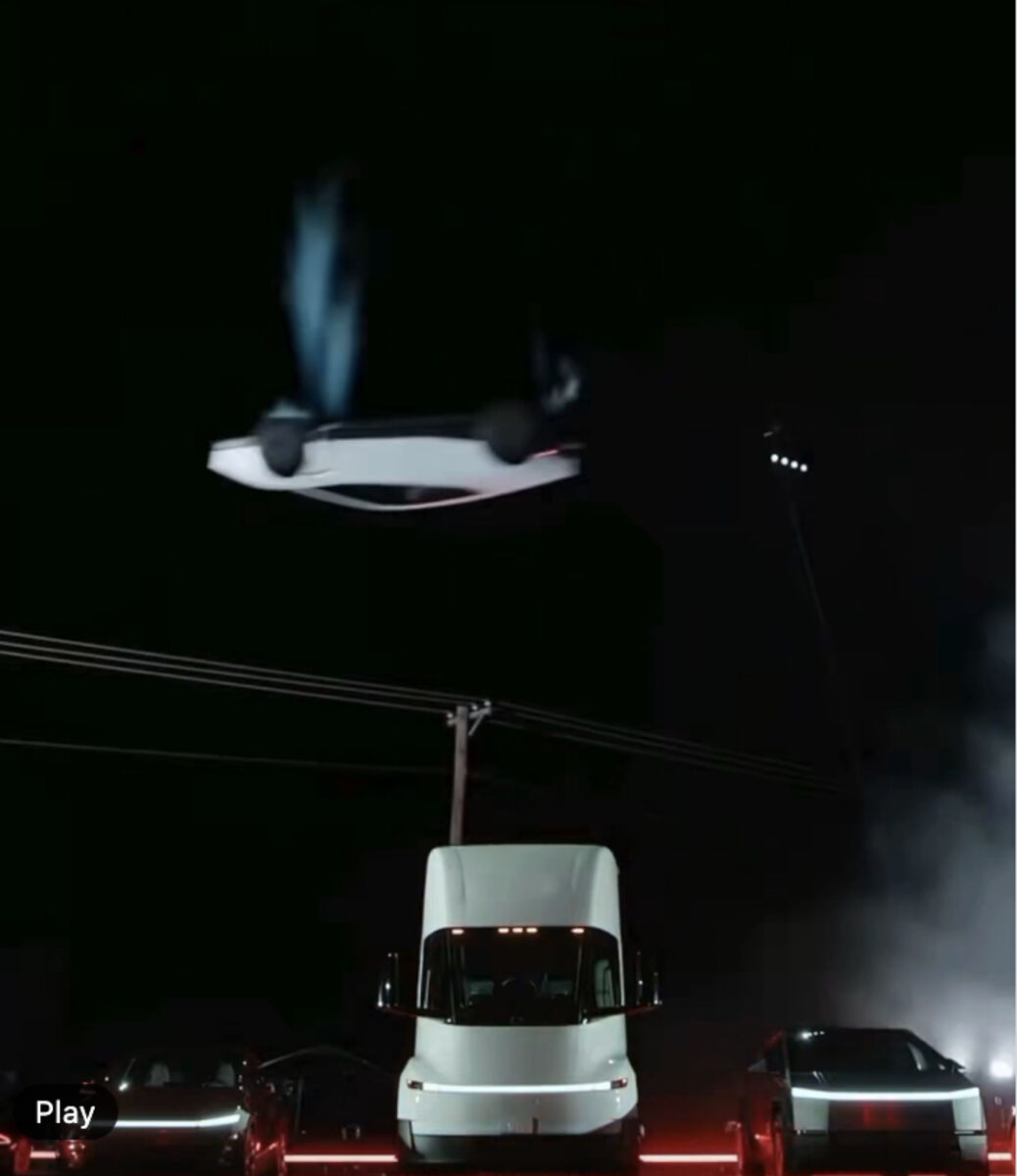
Elon Musk Builds Actual Flying Car!
The inverted driving occurred on a specialized curved/overhead ramp structure, not a public road. The fan suction system pinned the car to the surface with sufficient force to counteract gravity and allow continued movement while inverted. Once it left the structure, thrusters rotated and controlled the vehicle through the air before it landed. This is a controlled demonstration of the suction technology's grip; it is not a feature for ordinary roads.
Configurations and commercial availability
Tesla is offering three main configurations (with the higher ones treated as "augments"):
Performance** (road-ready, two seats): Active aerodynamics + multi-mode suction system. Claimed 0-60 mph under 1.6 seconds. Available by reservation ($50,000 deposit).
Thrust** (race-ready, two seats, limited release): Adds rear cold-gas thrusters for sub-0.9-second 0-60 mph. Higher deposit ($250,000).

Rocket** (air-ready, single seat, invite-only): Full perimeter thrusters enabling the demonstrated short hops, flips, and rotational maneuvers. Tesla states it "can fly" but notes it is "not approved for public road use." Claimed 0-60 mph under 0.59 seconds, top speed over 230 mph, and range over 300 miles.
Elon Musk stated at the event that production is targeted for 2028. Final purchase prices have not been announced (earlier 2017 figures of roughly $200,000+ are outdated). Reservations are open, but the vehicle has a long history of delays-the original next-gen Roadster was shown in 2017 with an earlier production target around 2020. Range and performance claims are lower in some areas than the 2017 concept (which targeted ~620 miles and four seats). Street legality of the thruster systems remains an open regulatory question.
The demonstration showcases extreme performance technology rather than a practical everyday flying car. The suction system is primarily aimed at track grip and cornering, while thrusters enable brief, high-force maneuvers and acceleration beyond tire limits.





Reader Comments(0)