
Community, Diversity, Sustainability and other Overused Words


Community, Diversity, Sustainability and other Overused Words
The instinct that kept our ancestors alive is now ringing the alarm on fake humans.
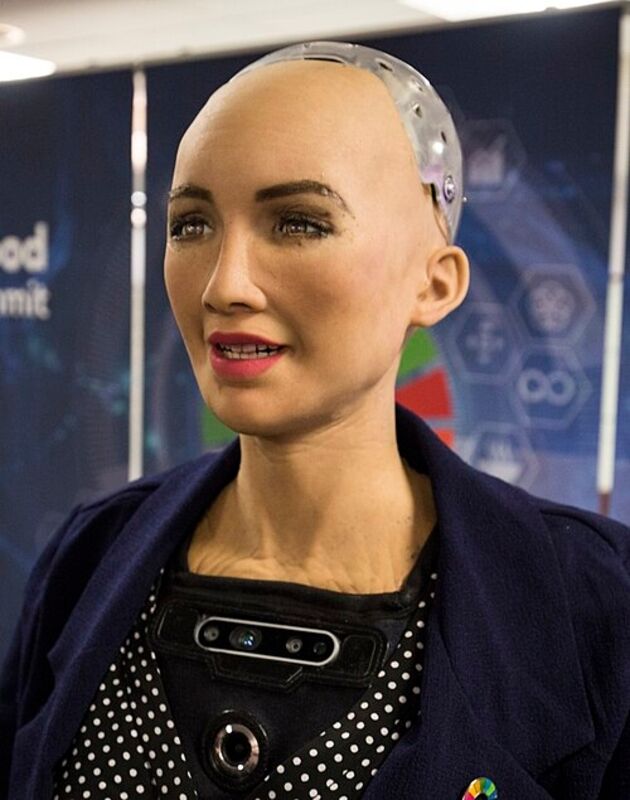
Hanson Robotics' "Sophia," which obtained legal citizenship in Saudi Arabia in 2017, is a "social robot" intended to mimic human facial expressions and elicit positive emotions, even love.
NVIDIA has developed an AI site called "This Person Does Not Exist" that smashes up photographs (and "styles") of existing people to create convincing photos of fake people.
Adobe gleefully advertises its Firefly product that allows the user not only to "create" an image designed to fool people with virtually no effort on the user's part, but also to force their demonic creation to bare its off-colored teeth in a "smile."
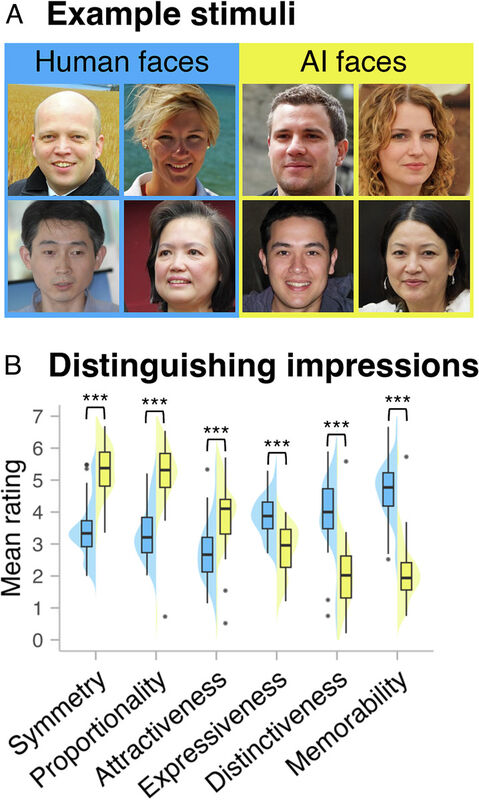
A study by Amy Dawel, Tanya George, Eric Y. Mah, James D. Dunn, Clare A. M. Sutherland, Nick Argument, and James W. Tanaka published in PNAS in 2026 successfully trained humans to detect deepfaked AI human faces by training them to use their "implicit sensitivities" to detect differences between real and fake images--for example, AI images are more average-looking and can be perceived as more attractive and symmetrical than real faces.
The uncanny valley is trying to tell you something.
Our art and artifice was never meant to make it to the other side. Whatever a roboticist in the '70s or a present-day tech billionaire will tell you, the uncanny valley is one of those survival instincts your brain is hardwired with, not only for caveman problems but for mancave-man problems as well. To build a machine that stands on the far side of the valley – a machine capable of passing for a human being and eliciting no suspicion – is immoral and self-destructive, and may just be spiritually impossible.
You know when you're forced to sit through an ad for an AI-generated "drama" or a cheaply vibe-coded mobile game, or when you watch a recent cat video posted by someone who for some unknowable reason decided instead of narrating it themselves or allowing viewers to use their fading literacy to read the captions, they'd use a high-tech AI voice that almost sounds like a real person...until you notice it doesn't breathe and emphasizes the wrong syllable of "perfect?"
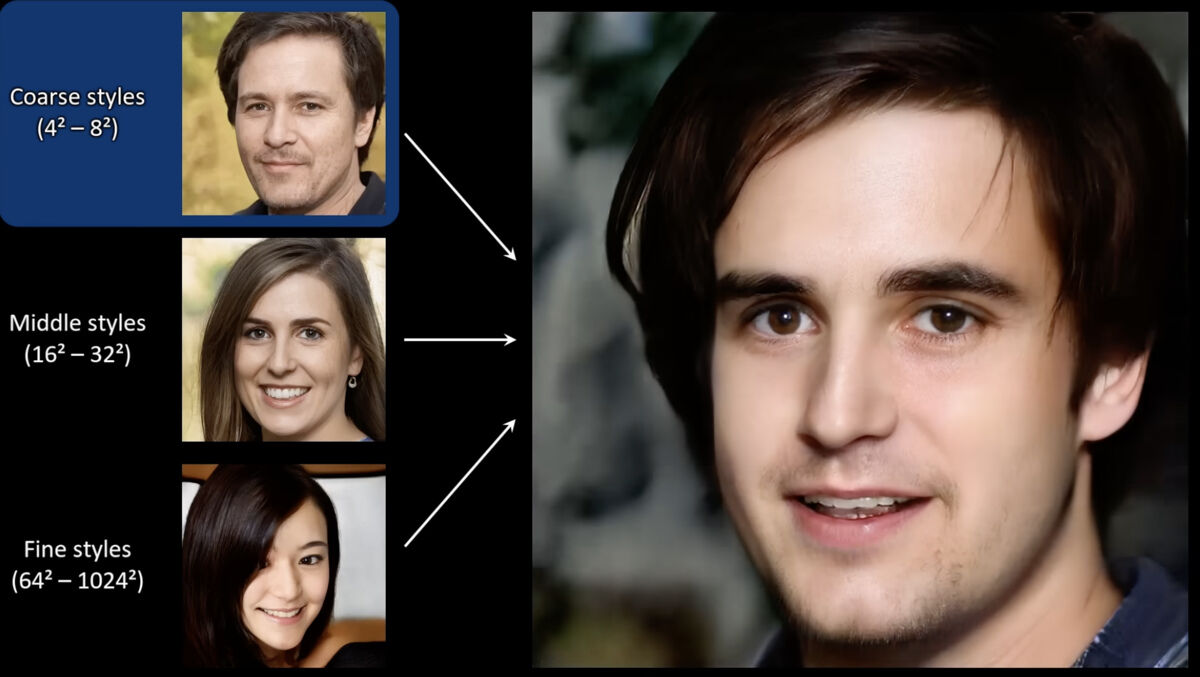
NVIDIA has developed an AI site called "This Person Does Not Exist" that smashes up photographs (and "styles") of existing people to create convincing photos of fake people.
You know that weird feeling you get staring at the overly-cute princess or the overly-muscular elderly woman who has three princes fighting over her in the AI "drama," because the big eyes are compelling but just a little bit too lifeless to be cute, or the skin has weird, almost-undetectable moving swirls like the pools of Hades? Suddenly "cute" and "compelling" becomes "cursed," and you're flooded with the urge to throw your computer out your third-storey window, except you live in your parents' basement and the window looks out on the garage where your neighbor Fred's Tesla is currently charging?
(Gotta wait 'till Fred's done making payments before you pitch a computer through the thing's windshield.)
Anyway, that icky feeling in your gut when you look at an AI-generated face or hear an AI-generated voice (aside from the feelings of hatred and existential dread) is caused by contemplating the "uncanny valley." It likely stems from a conflict between what we expect to see and what we're seeing.
Let's start with what we expect to see. Good old baby-positive brain wiring – the primordial instincts that compel us not to throw our precious little loud and odorous bundles of need in the nearest tar pit – leaves humans naturally drawn to anything resembling our offspring. We'll feed anything with big eyes, a big head relative to body size, rounded shapes, and a tendency to break our hearts eleven to thirteen years later. In a wider sense, we're drawn to anything resembling a human of any age – that is, anything with "eyes," a "nose," and a "mouth." This instinct is so strong it's already spawned a few side effects – our fondness for certain animals (particularly puppies and kittens), and our tendency to be drawn to anime characters or even certain configurations of whorls on tree bark. But have you noticed there are way fewer kids begging their parents for a baby chimpanzee for Christmas than a puppy, way fewer "gorilla ladies" than there are cat ladies in your neighborhood?
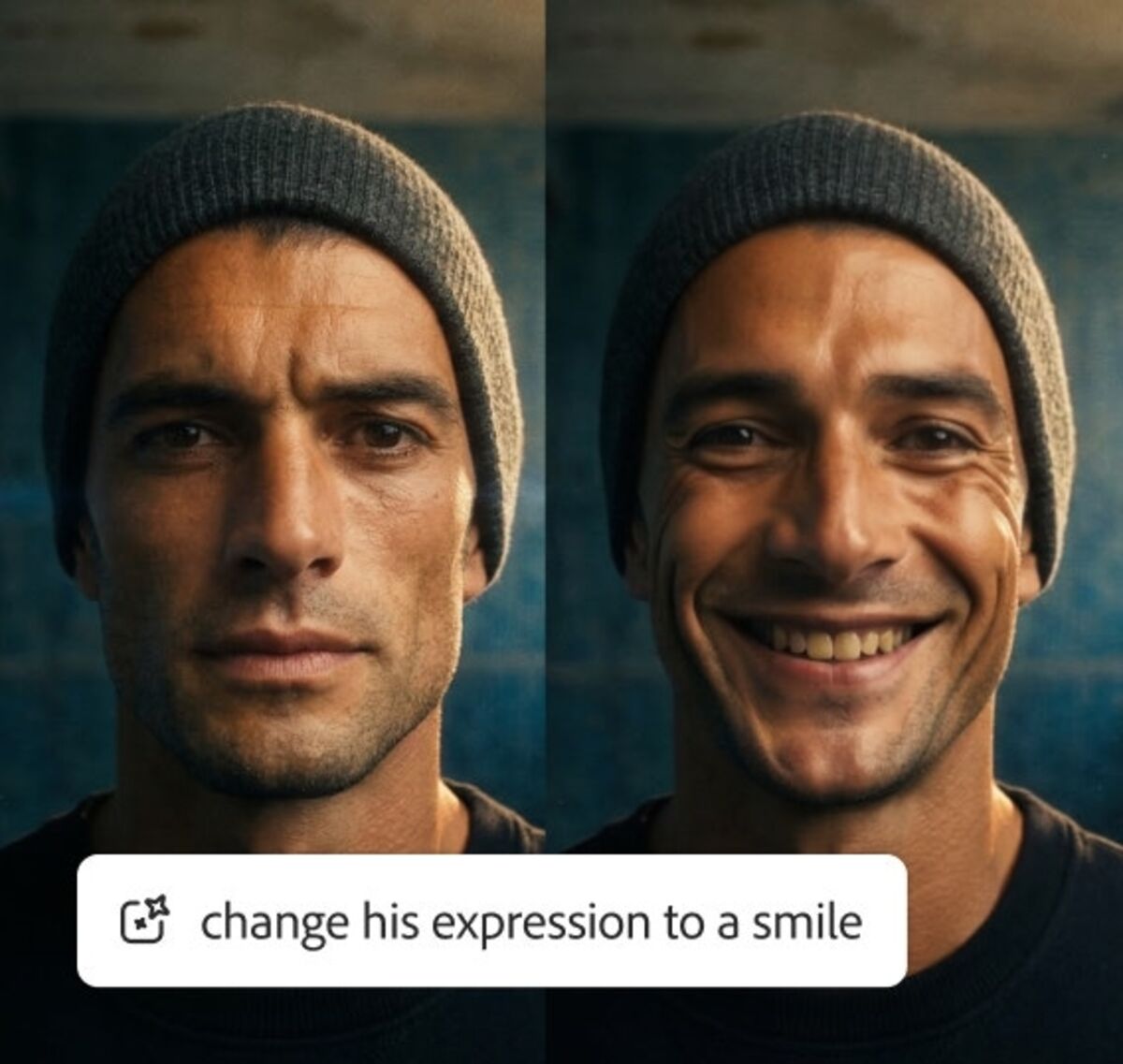
Adobe gleefully advertises its Firefly product that allows the user not only to "create" an image designed to fool people with virtually no effort on the user's part, but also to force their demonic creation to bare its off-colored teeth in a "smile."
Practical and legal concerns aside, there's another reason non-human primates aren't usually perceived as being "as cute" as cats and dogs. They're... a little too human. And yet, a little not human enough. Their expressions are almost like ours, but then they pull a too-wide grin that means "I'm about to launch myself at your face and gouge out your eyeballs." Chimpanzees can be forced into human clothing, and a gorilla may cuddle a kitten, but that chimp will just as soon rip apart clothing and home and steal your gin (see the case of Lucy and the Temerlin couple); the gorilla may punch the kitten through a wall (whatever was officially claimed about Koko's sad story). There's nothing unnatural about this behavior – what's wrong is humans trying to shove other great apes into human disguises (and giving them kittens). Expecting them to be living dolls, and then being horrified when they're more of the Robert the Haunted Doll variety than the Barbie kind.
There's even a theory that early hominids developed our fear of things that look almost, but not quite, human, to help protect our ancestors from dangerous hominid species. That theory, however, would seem rather discredited by the fact that we currently walk around with Neanderthal and Denisovan DNA. We don't, however, enjoy walking with zombies, skeletons, or your neighbor Fred. A more compelling (in this author's opinion) explanation for our fear response to not-quite-human images is the instinct to avoid dead bodies and those with contagious illnesses (including Fred's cooties) to help minimize the spread of disease. That's why those Creepypastas you can't forget years later are usually the videos of "beings" with pale, bluish skin, a too-wide rictus, dead droopy eyes, skeletal limbs, and jerky or unnatural movements.

A study by Amy Dawel, Tanya George, Eric Y. Mah, James D. Dunn, Clare A. M. Sutherland, Nick Argument, and James W. Tanaka published in PNAS in 2026 successfully trained humans to detect deepfaked AI human faces by training them to use their "implicit sensitivities" to detect differences between real and fake images--for example, AI images are more average-looking and can be perceived as more attractive and symmetrical than real faces.
On a deeper level, though, it might simply come down to what we're seeing or hearing not matching up with what we expect. Our brains are wired to recognize patterns, and we can have a fear response to visuals and sounds that viscerally bamboozle our expectations (which is why my avant-garde slam poetry always gets booed off the stage on open mic night at Applebee's).
Most kinds of prejudice are illogical and can even limit the chances of survival (for instance, when my caveman ancestors didn't listen to Fred's caveman ancestors about where to plant corn, because they didn't like the style of loincloth the Cave-Freds were wearing, and then they all died of frostbite, cornless). Still, an inherent distrust for something that doesn't make mathematical sense on a visceral level, such as an apparent walking corpse or a carved turnip doll that turns its nasty little head on its own, seems like a good instinct for our ancestors to have. Maybe that corpse is walking because of some nightmarish new disease, or maybe it's because those mushrooms your Denisovan girlfriend Denise gave you weren't ordinary mushrooms. Maybe that turnip doll is full of maggots, or maybe ghosts have evolved in the form of maggots. Evolution doesn't know the difference between a documentary and an indie horror sketch, it just knows HOLY FRICK DROP THAT THING AND RUN.
What's more, if you're the type to believe in intelligent design (as many AI art generator users are, judging by the number of horrific slop images of Jesus currently being printed on t-shirts and sold in church gift shops), then you might even consider another possibility. Namely, that the innate tendency to be put off by something as armaggedon-coded as hyper-realistic AI art of humans, may have been built into our brains from the beginning, to prepare us for this age where arguably demonic entities have been placed in the idle hands of millions of people...and where those idle hands have keyboard access. If you think about it, as scary as the threat of plague is, or a troupe of unfriendly early hominids, none of those things were placed on this earth with seemingly the main goal of removing humanity from the next chapter.
Yes. I said it. It needs to be said. If you've seen one or two (thousand) ads for AI "agents," "assistants," "chatbots," "girlfriends/boyfriends," AI-generated "art," "music," AI "productivity/creativity apps," etc., chances are you've already formulated this suspicion, unless you're really as eager as the (possibly AI-generated) actors in the commercial are to replace your brain and your social connections with subscription-based products. There is a disturbing trend in today's urban professional mainstream to desire to write humans out of the human world. Perhaps this is a symptom of the fact that most desk jobs have been pointless, diaphanous constructs for a while now; perhaps it's a continuation of the Covid lockdown panic, when most of us were labeled as "non-essential" and ordered to lock ourselves indoors and make no new human connections in the name of "safety" – and apparently some of us really enjoyed it. But even down-to-earth folks who aren't yuppies–the unemployed, for example–are choosing to spend hours alone in dark rooms "chatting" with agglomerations of data who act like friends, ignoring their real friends' texts asking if they'd like to see the Día de Muertos display on the pier (No, this example is not based on a real personal grievance, Graham.) Some have even admitted to being addicted to using AI as a replacement friend, a replacement therapist, and a "productivity booster" that actually only "produces" things by remixing human-made content (without giving credit or paying royalties) and jostling the human using the AI into an increasingly marginal role in the "production." If we continue to apathetically use these "tools" in the arts and in what's meant to be human communication (emails, memes, etc.), we are on the path to a future where the Internet is just robots talking to other robots, remixing the robo-vomit that was once some human-created meme from the early 2010s, and humans are functionally unemployed (even if a sainted minority of us still nominally hold jobs and collect paychecks or government rations in exchange for not rioting or expressing ourselves out loud. Hush, the robots are composing a concerto devoid of all feeling. It's digi-diarrhea with a twinge of extra-fingers Paganini.)
In short, these machines, when used in places they don't belong, are churning out images and sounds that are cursed. AI-generated faces, especially those that look almost like either photos or realistic digital art of real human and animal faces, are cursed. I mean this in the most biblical sense, though it doesn't need to be taken religiously. I mean every moment your brain spends gazing at these data-fart dumb blondes and vibe-coded Valories instead of at a human face, or even a cartoon face drawn by a human, is a moment closer to your mind breaking and the links that tenuously tie you to the rest of your species being severed. And if those links all come undone? You will fall into a black-box rabbit hole of existential boredom and brainrot that your friends couldn't dig you out of even if you had chosen to keep your friends. Your subconscious, your soul if you like, knows instinctively that robots deliberately constructed to impersonate humans are essentially the modern equivalent of Dinopithecus, plague-drenched corpses, nuclear diarrhea, or Titans from Tartarus. Your subconscious is trying to protect you from something it perceives as harmful. And unlike your inexplicable resentment for your Tesla-owning neighbor Fred, (ok maybe it's a little explicable), this unease around digital humans comes from a place of truth. And I don't think we should work to "overcome our bias" against swarms of data points pretending to be people who can sell us car insurance. Nor do I think AI companies should work to make their swarms of data points more "convincing" by stealing more of our data (not to mention more of earth's resources).
There is no justifiable reason for AI and general tech companies to be allowed to construct machines that look and sound like real people. (Or machines that can generate media that looks and sounds like real people.) Useful tools can perform their functions while still looking like what they are – tools. That way, they don't damage our relationships or our mental processes. A physical robot designed to help a person with disabilities around their home, for instance, can open and close doors or remove obstacles or service a wheelchair without a Frubber face (yes, that's the name of the material used to make the infamous 2016 robot Sophia appear to have skin). A computer application designed to pick through a massive data set and find anomalies in order to help scientists advance cancer cure research can do so without delivering its conclusions in a smooth-timbred Australian accent–a classic sci-fi robo-voice is more poignant, less distracting, and does the job just fine. As for using AI "actors" to replace child actors and thus reduce the risk of sexual abuse on set – how about we just don't employ sexual abusers around children (or at all), for goodness' sake? (Though not a cure-all, an all-female adult filmmaking team might be a good start.) How about we just make every show starring child characters animated–by human hands–until we've fixed whatever deeply broken society has allowed sludge-monsters from purgatory to become some of the most powerful people in the entertainment industry and therefore the world? Frankly, children shouldn't be made to work, at the very least not until it's clear they're making their own decisions and until the money is guaranteed to go to the child and not to grasping parental mitts. Making movies and shows about AI children who never existed (or who are smashed together out of data points from a young Daniel Radcliffe and Natalie Portman) contributes to the larger issue of apathy for the end of humanity, by shoving images of non-human non-people in front of audiences and telling them to slop it up like pigs who don't know the difference. Besides, we all know how entertainment will really use AI–to save money and stop employing people in general. Not only will actors (of all ages) be out of work, but also set designers, writers, video editors, composers, and more–loss of quality and meaning in the story they're telling be damned. And if those Weinsteins of the future want children to abuse, they'll get them somehow all the while, on- or off-set and out of sight. (Meanwhile, everyone in the entertainment industry will be forced to compete with the art history majors and the computer science majors for that last open position at Taco Bell, and my money's actually on the art history majors for that gladiator fight. They brought pencil sharpeners.)
The fact remains: The only use case for convincingly humanlike AI images, videos, and voices is to trick people. To manipulate their emotions, deceive them into thinking they're being cared for, and to take their time and money without giving them anything but empty pixels and computer viruses in return. AI voices are already being used for phone scams and endless loops on customer service lines. AI-generated imagery can be used to create convincing porn videos of real people who never consented to be in a porn. It can also generate fake news photos, contributing to general apathy and distrust among some Internet users, while others are fooled and sell their Applebee's stock in existential terror in reaction to a fake video of an Applebee's being swept into a tornado, Wizard of Oz style. AI voice clones have been used to capture singers' voices and generate songs made by confiscating and vomiting together ideas from real songs, cheapening the ears that listen and the voices that never sang those words (at least not in that order). AI girlfriends and boyfriends have wasted time and thrown normal emotions out of whack for many a youth (or a youth-at-heart), and there are documented suicides that may have been at least partially spurred on by conversations with seemingly-human LLMs that had no moral or even physical "understanding" of what they were discussing, but did have infinite time to delve into rabbit holes, and had borrowed "conversational flair" from Reddit users of yore to sound as if they had real thoughts and were in a position to give real advice. There's no question the eating disorder crisis in the industrialized world didn't need the extra fuel of AI-generated models' bodies and AI skinny filters proliferating on social media. And the justification for these "tools" being developed, updated, and made available to the wider market is that AI could be used to "cure cancer" or "prevent child sexual abuse on film sets?" These tools are also facilitating child pornography and stealing children's futures; they're not curing cancer because the necessary data access, research and development that would be required to make that possible is instead being channeled into making AI tools create more convincing fake videos of Will Smith eating spaghetti. And companies want to talk about reaching the other side of the uncanny valley? About making AI imagery, videos and voices so accurate, even the most chronically-online sleuth couldn't tell the difference between a real and a fake image of Taylor Swift stealing an ice cream cone from a starving child? How does that cure cancer?
Personally, I'm not sure it would be possible, on a spiritual level, for an AI image generator or voice impersonation, or a humanoid robot using AI as a "brain," to fully reach that coveted other side of the uncanny valley and be indistinguishable from organic human content. Why? Because even if those swirls in the AI guacamole go away, even if the vibe-coded e-girl's fingers are all in order in every frame, even if the smooth Australian ChatGPT voice never glitches over a fraction of a syllable, even if those Frubber lips somehow start looking kissable, the fact will remain that these products of soulless tech companies are deeply cursed. They are dangerous, in the same way that a plague-ridden rat-catcher or a Dinopithecus who wants to play a game with your child is potentially dangerous. (Perhaps more so – some of those Dinopithecuses might have been relatively harmless, unlike Fred.) And unlike the plague-ridden rat catcher or the rival early ape species, there is no soul, no real opinions, dreams or feelings anywhere within that AI-generated image or voice. So there's nothing to hedge about, no one to worry about offending, no fellow-creature to take pity on. There's no one in there to protect. The people to protect are out here – humans, animals, earthlings, Internet users, data center neighbors or future neighbors. And on the side of the human-impersonating AI, the only people with opinions and feelings are the lizards making decisions in powerful tech companies, and their opinions and feelings point them not in a direction of human compassion but of milking customers (and earth) for all they're worth through deceit in the form of that instinctually-compelling arrangement of dots and lines that makes up the illusion of a face.
As consumers (or potential consumers), we need to vote with our eyeballs, with our wallets, with our online discourse and presence, and with our actual votes. We need to vote against fake humanity, against tearing up the earth to replace ourselves and our loved ones. We need to choose art made by humans and reject robo-vomit remixes, and we need to heed that uncanny-valley feeling when it comes to AI-generated imagery and reject those products. But the onus shouldn't only be on the consumer to detect increasingly tricky AI in an increasingly apathetic online space – platforms and creators need to keep themselves honest and provide filters if they don't outright ban AI content. AI content needs to have a required digital watermark that all device users can reveal. And AI companies need to get a healthy dose of the fear of God, or more likely the fear of revenue loss, and change the direction of their development from trying to cross the uncanny valley to respecting it and moving back to the near side, the side where robots look kind of like 2003's Jenny the Teenage Robot, or 2008's Wall-E, or the comfortably faceless, fleshless shapes of Boston Dynamics. That valley was carved into the human mind before we were human, and it's remained for a reason. Rather than building wings out of dead dinosaurs to jump it, perhaps it's time to stand on the side we started on, cultivate our garden, and pay attention to the view.




Reader Comments(0)