
Community, Diversity, Sustainability and other Overused Words


Community, Diversity, Sustainability and other Overused Words
"The way to stop discrimination on the basis of race is to stop discriminating on the basis of race."
Texas rep. Jasmine Crockett is a target of Texas redistricting. "The only thing progressive about Donald Trump is his dementia."
Democrats hold 13 Texas congressional districts. That might have fallen to 9 under the redistricting plan.
Lula vs Greg Abbott lawsuit.
Washington, D.C. – November 18, 2025 -- In a significant blow to Republican efforts to reshape the U.S. House ahead of the 2026 midterms, a three-judge federal panel in El Paso, Texas, blocked the state's newly enacted congressional map on Tuesday, finding it likely constitutes an unconstitutional racial gerrymander. The decision, which mandates the use of the 2021 maps for the upcoming elections, comes amid a nationwide surge in redistricting battles and could have ripple effects for a parallel lawsuit challenging California's voter-approved redistricting plan under Proposition 50.
The Texas ruling, authored by U.S. District Judge Jeffrey Brown-a Trump appointee-highlights "substantial evidence" that the 2025 map, signed into law by Gov. Greg Abbott in August, was drawn with racial considerations as the predominant factor, in violation of the Equal Protection Clause of the 14th Amendment. "The map ultimately passed by the Legislature and signed by the Governor-the 2025 Map-achieved all but one of the racial objectives that DOJ demanded," Brown wrote, quoting Chief Justice John Roberts' 2007 opinion in Parents Involved in Community Schools v. Seattle School District No. 1: "The way to stop discrimination on the basis of race is to stop discriminating on the basis of race."
The map in question was part of a mid-decade redistricting push spearheaded by President Donald Trump, who urged GOP-led states to redraw lines to secure additional House seats. Texas' plan aimed to flip up to five Democratic-held districts, potentially giving Republicans 30 of the state's 38 seats despite their 56% statewide vote share in the 2024 presidential election. Critics, including civil rights groups and Democratic lawmakers, argued it "packed" and "cracked" minority communities-predominantly Latino and Black voters-to dilute their influence and entrench GOP advantages.
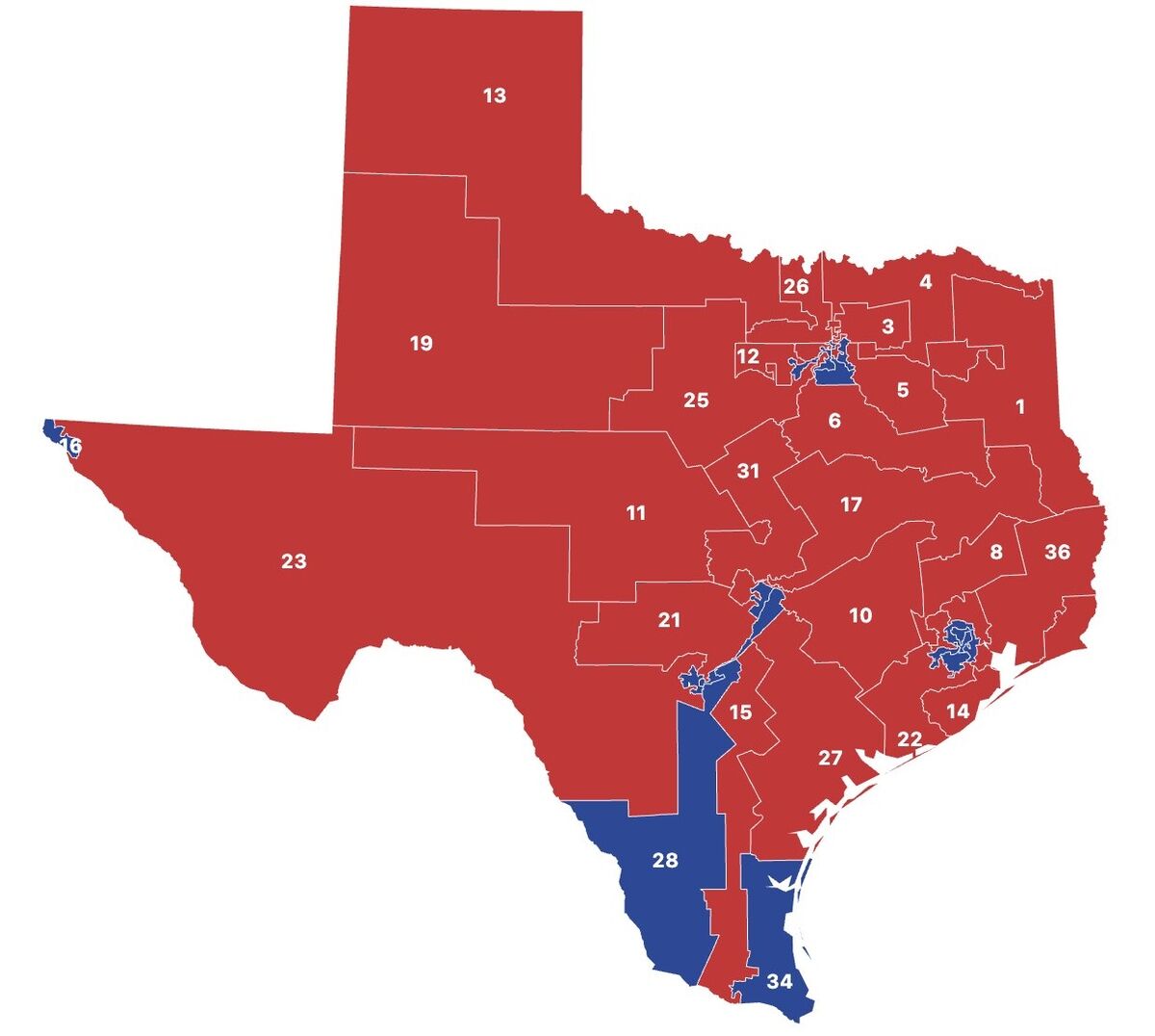
Democrats hold 13 Texas congressional districts. That might have fallen to 9 under the redistricting plan.
Texas Attorney General Ken Paxton immediately vowed to appeal directly to the U.S. Supreme Court, calling the lower court's decision "a blatant overreach by activist judges." Paxton's office has until early December to file for an emergency stay, setting the stage for a potential high-court showdown before the 2026 primaries. Legal experts note that while the Supreme Court has barred federal courts from policing partisan gerrymandering since its 2019 Rucho v. Common Cause decision, racial gerrymandering claims remain viable under the Voting Rights Act and the Constitution.
Echoes in California: A Mirror Image for Proposition 50
The Texas decision arrives just days after California voters overwhelmingly approved Proposition 50 on November 4, a ballot measure pushed by Gov. Gavin Newsom to counter Texas' gerrymander by redrawing the Golden State's congressional districts in Democrats' favor. The proposition, which amends the state constitution, discards maps drawn by California's independent citizen commission after the 2020 census and installs new lines designed to flip up to five Republican-held seats, potentially netting Democrats a net gain of zero when offset by Texas' ambitions.
But Proposition 50 has faced swift legal backlash. Hours after its passage, the California Republican Party, represented by the Dhillon Law Group, filed a federal lawsuit in the U.S. District Court for the Central District of California, alleging the new maps unconstitutionally prioritize Latino voters at the expense of others. The suit cites statements from Democratic mapmakers, including consultant Paul Mitchell, who described the boundaries as empowering "Latino voters to elect their candidates of choice," as evidence that race predominated over traditional redistricting criteria like compactness and community interests.
On November 13, the U.S. Department of Justice under Attorney General Pam Bondi intervened in the case, filing its own complaint against Newsom and Secretary of State Shirley Weber. The DOJ argues that Proposition 50's maps violate the 14th and 15th Amendments by using "race as a proxy to advance political interests," echoing the very language Judge Brown invoked in Texas. "California's redistricting scheme is a brazen power grab that tramples on civil rights and mocks the democratic process," Bondi said in a statement. Principal Deputy Assistant Attorney General Jesus A. Osete added, "Californians were sold an illegal, racially gerrymandered map."
A preliminary hearing is scheduled for late November, where plaintiffs will seek an injunction to revert to the commission's maps for 2026. Nonpartisan analyses, such as one from the Public Policy Institute of California, confirm the new boundaries maintain the same number of majority-minority districts as before but rearrange them in ways that align Latino populations with Democratic-leaning areas.
Broader Implications for 2026 and Beyond

Lula vs Greg Abbott lawsuit.
This cross-state legal tit-for-tat underscores the fragility of America's redistricting process, exacerbated by the Supreme Court's 2019 Rucho ruling, which Chief Justice Roberts deemed partisan gerrymanders "political questions" unfit for federal judicial review-unless race is the driving force. As election law professor Rick Hasen of UCLA noted, the decision has "opened the floodgates" for states to pursue aggressive maps, with racial claims becoming the primary battleground for challenges.
In Texas, the federal panel's finding of racial predominance could embolden Supreme Court justices wary of skirting Rucho through backdoor racial arguments, as flagged in a recent South Carolina case. For California, the symmetry is striking: Both states' plans seek partisan gains via racial sorting, but the Texas ruling provides a template for plaintiffs to argue that voter-approved measures like Proposition 50 cannot launder unconstitutional discrimination. "The court in Texas just handed challengers in California a roadmap," said Sophia Lin Lakin of the ACLU's Voting Rights Project. "If race can't justify diluting minority votes in one state, it can't empower them as a partisan tool in another."
With Republicans controlling redistricting in states like Florida, Ohio, and Missouri-potentially netting nine or more seats-and Democrats countering in Illinois and New York, the 2026 midterms hang in the balance. A Supreme Court intervention could redefine boundaries not just for these two states but for the national map, forcing lawmakers to confront whether mid-decade redraws undermine the decennial census mandate.
As Paxton and Bondi prepare their appeals, civil rights advocates warn of a "gerrymandering arms race" that erodes trust in elections. "This isn't democracy; it's districting for dominance," said Dale Ho, director of the Brennan Center for Justice's Voting Rights and Elections program. For now, the 2021 maps remain in place in Texas, preserving a fragile status quo as the nation braces for what could be the most litigated redistricting cycle in modern history.




Reader Comments(0)