
Community, Diversity, Sustainability and other Overused Words


Community, Diversity, Sustainability and other Overused Words
This shift, which occurred within the past 48 hours, has effectively sidelined more pragmatic civilian figures, e.g. Foreign Minister Abbas Araghchi, leaving Iranian political negotiators without authority
This shift, which occurred within the past 48 hours, has effectively sidelined more pragmatic civilian figures, including Foreign Minister Abbas Araghchi, leaving Iranian political negotiators without independent authority
IRGC Hardliners Seize Control of Iran's Military and Diplomatic Posture Amid US Talks; Moderates Sidelined This shift, which occurred within the past 48 hours, has effectively sidelined more pragmatic civilian figures, e.g. Foreign Minister Abbas Araghchi, leaving Iranian political negotiators without authority
WASHINGTON - In a marked escalation of internal power struggles within the Iranian regime, Major General Ahmad Vahidi, commander of the Islamic Revolutionary Guard Corps (IRGC), and his inner circle have assumed at least temporary dominance over both Iran's military operations and its negotiating stance toward the United States, according to an assessment by the Institute for the Study of War (ISW) released on April 19, 2026.
This shift, which occurred within the past 48 hours, has effectively sidelined more pragmatic civilian figures, including Foreign Minister Abbas Araghchi, leaving Iranian political negotiators without independent authority to shape policy. The development coincides with a sharp reversal in Iran's approach to the Strait of Hormuz and comes as a fragile ceasefire-originally tied to parallel de-escalation in Lebanon-faces uncertainty ahead of its potential expiration on April 22.
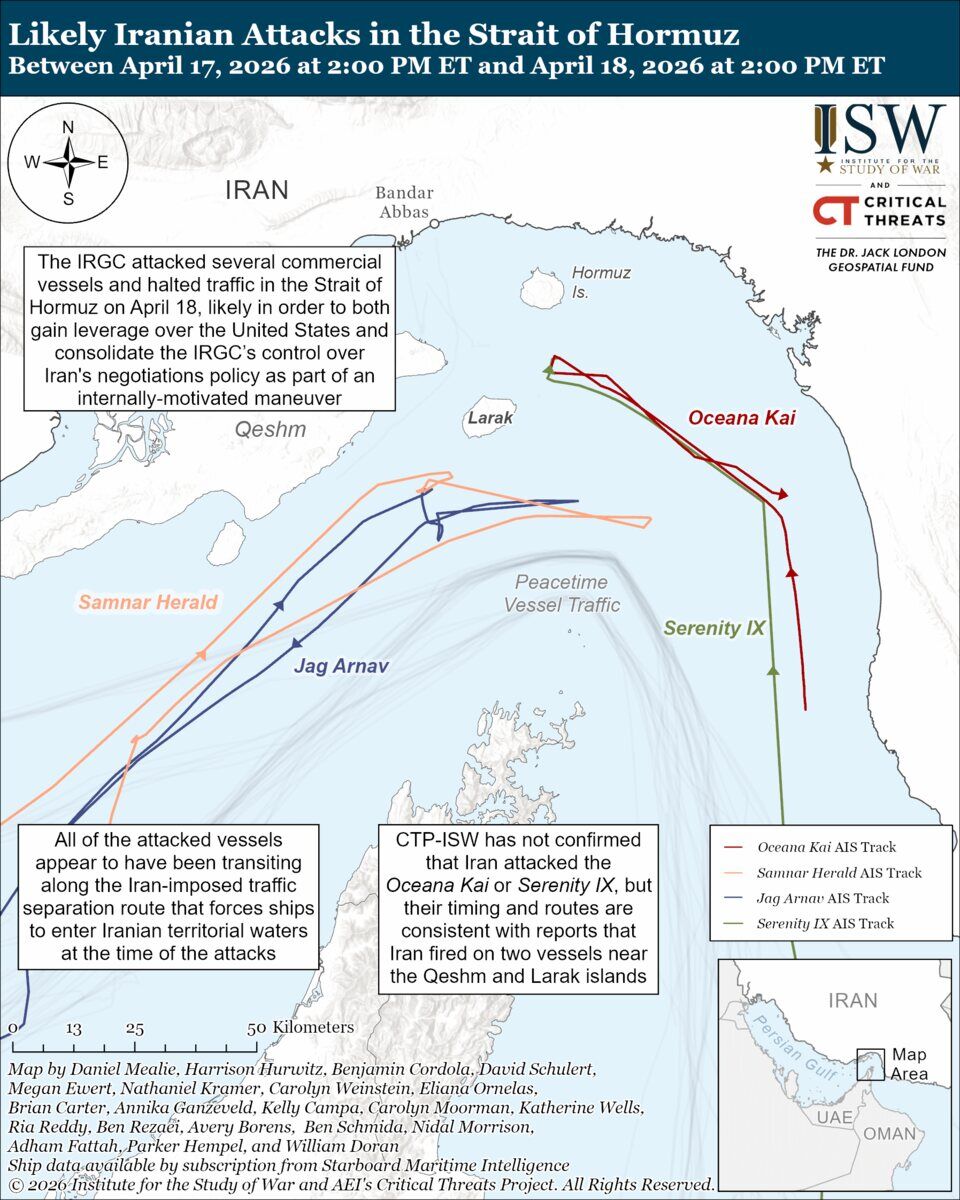
On April 18, IRGC naval forces attacked multiple commercial vessels in the Strait of Hormuz and declared the critical chokepoint closed to all non-Iranian traffic, regardless of type or nationality. This action directly contradicted Araghchi's announcement the previous day that the strait was "completely open" to commercial shipping during the ceasefire period. Maritime tracking data indicate that traffic through the waterway has since virtually halted, except for Iranian vessels, with shipping companies demonstrating reluctance to transit amid heightened risks.
The IRGC's moves appear calculated to achieve dual objectives: externally, to exert economic leverage on the United States and its allies by disrupting global oil and shipping flows, thereby driving up prices; internally, to consolidate the Guard's authority within the regime and demonstrate its primacy over foreign policy decisions traditionally reserved for civilian leadership. IRGC-affiliated media outlets simultaneously announced that Iran would not participate in further negotiations with Washington, citing "excessive" U.S. demands.
Vahidi, a longtime IRGC veteran and close associate of Supreme Leader Mojtaba Khamenei, has long exerted influence beyond his formal military remit. Analysts note that he and affiliates such as Supreme National Security Council Secretary Brigadier General Mohammad Bagher Zolghadr have clashed with pragmatists like Araghchi and Parliament Speaker Mohammad Bagher Ghalibaf over the scope and concessions possible in indirect talks held in Islamabad, Pakistan. Those discussions, which failed to produce agreement on core issues-including Iran's uranium enrichment program, its stockpile of highly enriched uranium, and freedom of navigation in the Strait of Hormuz-highlighted deep factional divides within Tehran.
IRGC Hardliners Seize Control of Iran's Military and Diplomatic Posture Amid US Talks; Moderates Sidelined This shift, which occurred within the past 48 hours, has effectively sidelined more pragmatic civilian figures, e.g. Foreign Minister Abbas Araghchi, leaving Iranian political negotiators without authority
The IRGC's consolidation underscores a structural asymmetry in Iranian decision-making: while political officials engage in diplomacy, hardline security institutions retain veto power over outcomes touching on core regime interests, including ballistic missiles, regional proxies, and maritime control. U.S. officials have explicitly conditioned any new round of talks on Iran fully reopening the strait and ensuring its negotiating delegation possesses genuine authority to finalize deals-an implicit acknowledgment of the fractured command structure.
Compounding the diplomatic impasse is the ongoing U.S. naval blockade of Iranian ports, enforced by U.S. Central Command (CENTCOM) assets. As of April 18, the blockade had forced 23 vessels to turn back since its implementation, with no Iranian ships attempting to challenge the line directly. CENTCOM reported additional interceptions in the preceding 24 hours, effectively severing Iran's seaborne economic lifelines and exacerbating domestic pressures on the rial and fuel supplies.
The current ceasefire framework, which included provisions for de-escalation in Lebanon and conditional reopening of the strait, remains precarious. Mediators, including Pakistan, have floated extensions, but U.S. statements suggest little appetite for prolongation absent tangible Iranian concessions. The IRGC's actions on April 18 represent not only a tactical bid for leverage but also an internal assertion of dominance at a moment when regime cohesion is under strain from battlefield setbacks, economic isolation, and leadership transitions following recent high-level casualties.
For scholars of authoritarian resilience and Middle Eastern security dynamics, this episode illustrates the persistent tension between ideological hardliners embedded in parallel military structures and technocratic elements seeking pragmatic survival. Whether Vahidi's ascendancy proves durable or provokes a counter-reaction from other regime stakeholders will likely determine the trajectory of any renewed diplomacy-or the resumption of open conflict-beyond April 22.
The situation continues to evolve rapidly, with global energy markets and maritime insurers closely monitoring developments in the Gulf.



Reader Comments(0)