
Community, Diversity, Sustainability and other Overused Words


Community, Diversity, Sustainability and other Overused Words
US Navy fires six rounds into the engine room of an Iranian-flagged cargo vessel Sunday, after it ignored six hours of repeated warnings and attempted to reach an Iranian port
US Navy fired six rounds into the engine room of an Iranian-flagged cargo vessel Sunday, after it ignored six hours of repeated warnings and attempted to reach an Iranian port
Map of the Touska incident.
Arabian Sea / Washington - April 19, 2026. U.S. naval forces fired six rounds into the engine room of an Iranian-flagged cargo vessel Sunday, after it ignored six hours of repeated warnings and attempted to reach an Iranian port in violation of a U.S. blockade imposed on Iranian maritime traffic. The action marks the first reported use of lethal force since the blockade began. centcom.mil
Guided-missile destroyer USS Spruance (DDG 111) intercepted the M/V Touska in the northern Arabian Sea as the vessel transited at 17 knots en route to Bandar Abbas, Iran. American forces issued multiple warnings, informing the crew that the ship was violating the U.S. blockade. After six hours of non-compliance, the Spruance directed the crew to evacuate the engine room and then fired several rounds from its 5-inch MK 45 gun into the vessel's propulsion system, disabling it. centcom.mil
U.S. Marines from the 31st Marine Expeditionary Unit subsequently boarded the ship, which is now in U.S. custody. Officials described the operation as "deliberate, professional, and proportional." centcom.mil
The Touska, a nearly 900-foot cargo ship previously sanctioned by the U.S. Treasury for illegal activity, is the 25th commercial vessel directed to turn around or return to an Iranian port since the blockade took effect. The previous 24 vessels complied without the use of force. centcom.mil
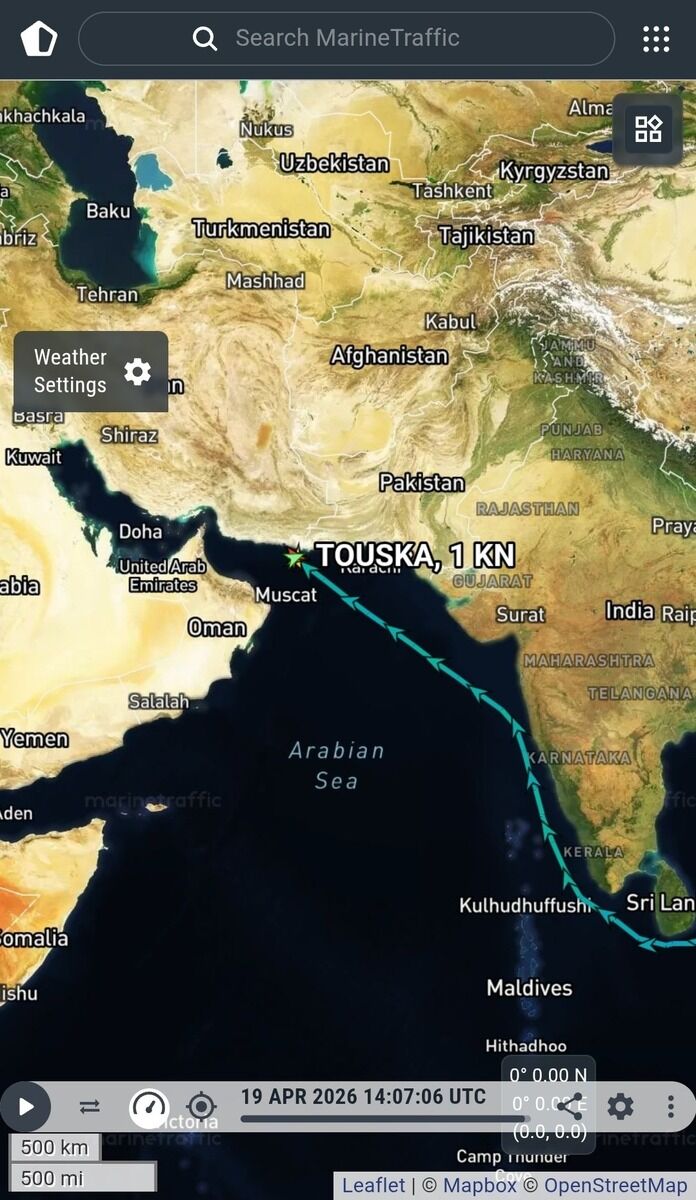
Map of the Touska incident.
President Donald Trump confirmed the incident in a Truth Social post, stating: "Today, an Iranian-flagged cargo ship named TOUSKA... tried to get past our Naval Blockade, and it did not go well for them. The U.S. Navy Guided Missile Destroyer USS SPRUANCE intercepted the TOUSKA in the Gulf of Oman, and gave them fair warning to stop. The Iranian crew refused to listen, so our Navy ship stopped them right in their tracks by blowing a hole in the engineroom. Right now, U.S. Marines have custody of the vessel."
thehill.com
Broader Context of the U.S. Blockade of Iran
The U.S. naval blockade of Iranian ports was implemented on April 13, 2026, following the collapse of peace talks in Islamabad, Pakistan, between U.S. and Iranian negotiators. President Trump announced that the U.S. Navy would prevent any ships from entering or leaving Iranian ports through the Strait of Hormuz and adjacent waters. npr.org
U.S. Central Command has emphasized that the blockade targets only vessels bound for or departing from Iranian ports and coastal areas. It does not restrict freedom of navigation for ships transiting the Strait of Hormuz to or from non-Iranian destinations. The measure is intended to enforce existing sanctions, halt Iranian oil exports (estimated at roughly 1.8–2 million barrels per day), and apply economic pressure on Tehran amid the ongoing 2026 Iran conflict.
reuters.com
The blockade is enforced primarily outside the strait in the Gulf of Oman and Arabian Sea by U.S. naval assets. Iran has responded by periodically closing the strait and issuing threats against vessels approaching the area. apnews.com
Sunday's incident represents a significant escalation in enforcement but remains limited to disabling propulsion rather than sinking the vessel or causing reported casualties. U.S. officials have described the overall strategy as part of a broader effort to compel Iran toward a negotiated agreement. The blockade remains in effect as of April 19.




Reader Comments(0)