
Community, Diversity, Sustainability and other Overused Words


Community, Diversity, Sustainability and other Overused Words
The latest budget represents a substantial increase from the earlier estimate of $28 million, driven largely by "soft costs" such as design, environmental review, permitting, and inflation adjustments
The pool budget represents a substantial increase from the earlier estimate of $28 million, driven largely by "soft costs" such as design, environmental review, permitting, and inflation adjustments
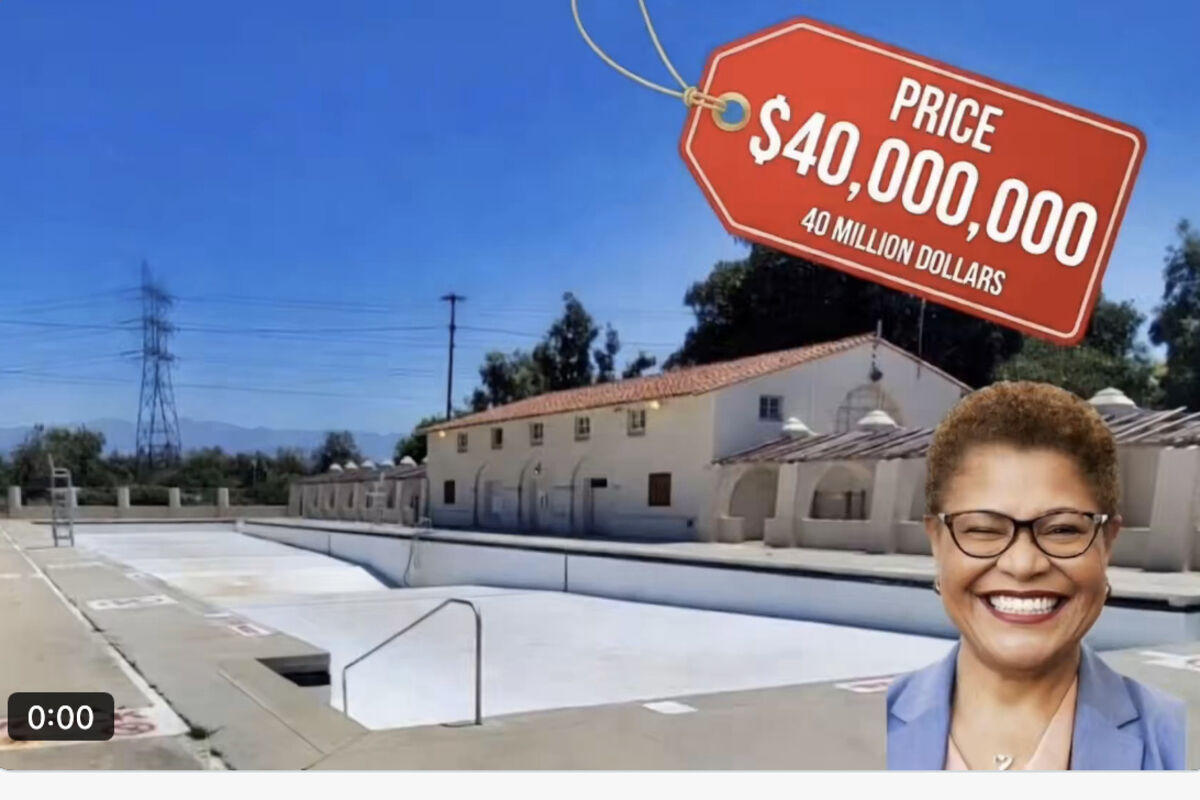
Santa Monica, California - The City of Los Angeles is moving forward with a $40 million reconstruction of the historic Griffith Park Pool, a project that has drawn scrutiny for its escalating price tag and extended timeline amid broader questions about public works efficiency in high-regulation jurisdictions.
Originally constructed in 1927, the Griffith Park Pool has remained closed since approximately 2020. The current plan calls for complete replacement of the leaking facility, including a new competition-standard pool, a separate recreational pool with splash pad, and extensive renovation of the historic pool house. The latter will incorporate gender-neutral changing rooms. Completion is projected for 2029. The latest budget represents a substantial increase from the earlier estimate of $28 million, driven largely by "soft costs" such as design, environmental review, permitting, and inflation adjustments.
A recent aerial video of the site shows the long-vacant, fenced-off pool, underscoring resident frustration over nearly a decade of lost recreational access in one of the city's flagship parks.
Comparative analysis reveals that Los Angeles's $40 million commitment places the project at the upper end of costs for similar municipal aquatic facilities nationwide. Recent national benchmarks place average commercial and public pool construction at approximately $488 per square foot (2024 data), with total project costs for smaller or simpler outdoor municipal pools typically ranging between $2 million and $10 million when adjusted for scope and inflation. Larger or more complex aquatic centers with competition and recreational components generally fall in the $15–25 million range in most mid-sized American cities.
Examples from lower-cost jurisdictions illustrate the differential. In Oregon and Washington, recent basic pool rebuilds or modest expansions have come in between $2 million and $3.1 million, with more complex projects reaching $7.9–10.9 million. In Florissant, Missouri (population approximately 50,000), a $10 million bond package covered aquatic facility renovations. In Leavenworth, Kansas, planning for a comparable indoor/outdoor aquatic center with lap and recreation pools was budgeted between $18–22 million for the base option and $24–26 million for enhanced amenities.
In contrast, high-cost coastal cities such as Los Angeles and San Francisco routinely experience significantly elevated totals. Structural factors particular to California include mandatory environmental reviews under the California Environmental Quality Act (CEQA), historic preservation requirements, stringent ADA compliance and seismic standards, prevailing-wage and union labor mandates (adding an estimated 13–35 percent premium), and elevated development fees. Soft costs alone in California have been documented at three to five times the level observed in lower-regulation states such as Texas. These elements, combined with scope expansions and permitting delays, routinely inflate public infrastructure budgets beyond national norms.
Public pool construction costs have risen nationally by approximately 90 percent per square foot over the past decade due to material and labor inflation. Even so, California's baseline remains structurally higher than peer projects in the Midwest, South, or Texas, where comparable outdoor municipal pool reconstructions or new builds frequently come in at half or less the per-project cost.
For residents of Santa Monica and the Westside, who share regional recreational resources with Los Angeles, the Griffith Park project raises familiar questions about fiscal prioritization, regulatory overhead, and the trade-offs inherent in delivering public amenities in one of the nation's most expensive and heavily regulated urban environments. City officials have not yet released a detailed line-item breakdown distinguishing hard construction costs from soft costs and compliance expenses.
The Santa Monica Observer will continue to monitor the project's progress and any potential regional implications for shared park and aquatic resources.

Reader Comments(0)