
Community, Diversity, Sustainability and other Overused Words


Community, Diversity, Sustainability and other Overused Words
Aviation incidents involving ground vehicles during landing or takeoff phases are uncommon but not unprecedented at major hubs like Newark
Just before the crash
After the crash
NEWARK, N.J. — A United Airlines Boeing 767 arriving from Venice, Italy, struck a light pole above the New Jersey Turnpike while on final approach to Newark Liberty International Airport on Sunday afternoon, 5.3.26, causing damage to a bakery delivery truck below and minor injuries to its driver.United Airlines Flight 169, carrying 221 passengers and 10 crew members, made contact with the pole around 2 p.m. as it descended toward Runway 29. According to New Jersey State Police and federal authorities, a landing gear tire and the underside of the aircraft also struck or brushed the tractor-trailer traveling northbound on the turnpike. Debris from the damaged light pole contributed to the impact on the truck.
Dashcam video from inside the truck cab shows the driver reacting to the roar of the low-flying jet moments before the violent jolt. The footage captures dust, debris, and shattered glass filling the cab as the vehicle is shaken. The driver, identified as Warren Boardley of Baltimore, sustained cuts to his arm and hand from broken glass. He was hospitalized briefly with non-life-threatening injuries and has since been released.
The truck, operated by Baker’s Express for H&S Family of Bakeries (associated with Schmidt Baking Company), was en route to deliver bread products to a Newark depot. Company officials reported that the trailer remained intact, with no damage to the cargo. Boardley was able to pull over safely and contact his employer after the incident.
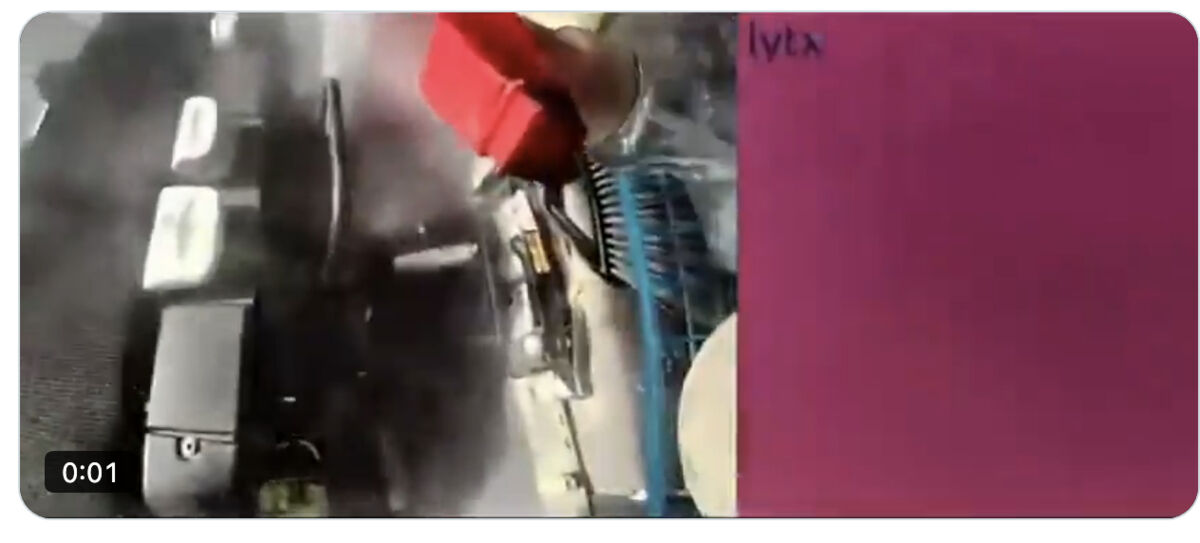
After the crash
The aircraft continued its approach, landed safely at Newark, and taxied normally to the gate. No injuries were reported among passengers or crew. United Airlines confirmed that the flight “came into contact with a light pole” during final approach.
The Federal Aviation Administration and National Transportation Safety Board are investigating the incident, which occurred amid reported gusty winds at the airport. Preliminary reviews will examine approach procedures, aircraft altitude, and coordination with ground traffic on the heavily traveled New Jersey Turnpike, which passes near the airport’s landing path.Such low-altitude encounters with highway infrastructure are rare but highlight the proximity of major roadways to Newark’s runways. Airport operations were not significantly disrupted beyond the immediate response.
Newark Liberty Airport is too Close to the Runway by Aakash Gupta
A United 767's landing gear just punched through a bakery truck driver's window on the New Jersey Turnpike. Here's the part the media isn't telling you.
This was a 75-year-old infrastructure decision finally cashing in. The chain was set in motion before any pilot showed up to work today.
Newark Airport opened in 1928 on New Jersey farmland. When the New Jersey Turnpike was routed in 1951, the cheapest path ran along industrial land that was already developed, which put the highway within feet of the airport boundary. Every other major US hub has a buffer zone between active runways and public roads. Newark traded its buffer for capacity in the Truman administration. Nobody alive made that decision, and nobody alive is going to undo it.
That single 1951 routing is why Runway 29's threshold now sits directly over the southbound Turnpike, lined with 40-foot light poles and active truck traffic.
Now play that geometry forward. Wind shifted at Newark today. One change closed the two long runways and pushed every arrival, including a 350,000-pound 767-400 fresh off an 8.5-hour transatlantic from Venice, onto the short runway. Runway 29 is 6,725 feet. A 767-400's minimum runway is 6,000 feet. With that little margin, you cannot land long. The crew has to put the gear down on the aim point or the plane runs off the end.
Robert Sumwalt, former NTSB chair, told CBS he assumed the pilots were intentionally flying low on final so they didn't land long. That is textbook procedure for a heavy on a short runway. The system worked exactly the way it's designed to work.
Flying low on final to Newark Runway 29 means crossing the New Jersey Turnpike at the altitude of a 40-foot light pole.
The tire clipped one. The pole came down on a Schmidt bakery truck heading to a Newark depot. The driver, Warren Boardley, got cut by flying glass when a 767 landing gear assembly came through his driver's-side window. He has been released from the hospital. The 221 people on the plane never knew it happened.
Newark has been on borrowed time for 75 years. The wind decides which day the bill comes due. -- Aakash Gupta, @aakashgupta on Twitter



Reader Comments(0)