
Community, Diversity, Sustainability and other Overused Words


Community, Diversity, Sustainability and other Overused Words
In the Laboratories of Tomorrow: The Birth of Chicks Without Shells. Or Hens.
Texas Biotech Company Hatches 26 Live Chicks from 3D-printed Artificial Eggs, With No Shells and No Hens.
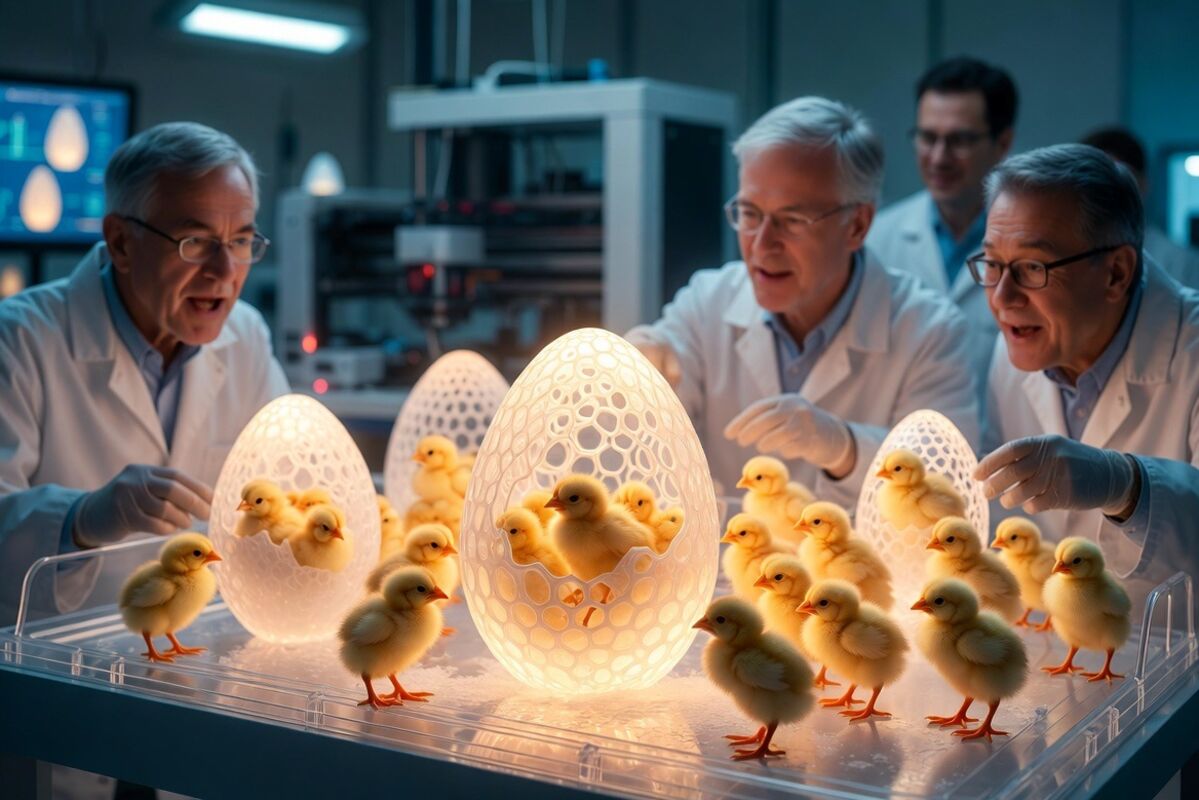
In the heart of Dallas, Texas, at the facilities of Colossal Biosciences, a quiet revolution in biology unfolded on May 19, 2026. For the first time in history, 26 healthy chicken chicks hatched not from a natural egg laid by a hen, but from a fully artificial system engineered by scientists. These were not creations from nothing-the embryos came from fertilized chicken eggs-but their entire development occurred inside 3D-printed containers that mimicked the essential functions of a real eggshell.
technologyreview.com
The artificial eggs featured a rigid lattice structure, often described as a grid of hexagonal shapes, 3D-printed for precision. Inside, a silicone-based membrane replicated the natural shell's ability to regulate gas exchange. This allowed oxygen to flow in and carbon dioxide to escape under normal atmospheric conditions-21% oxygen, the air we breathe-without needing supplemental gases. The design also maintained proper humidity and provided mechanical support, all while fitting into standard commercial incubators used on farms and in labs. A clear viewing window at the top let researchers watch every stage of development, from early embryo to the moment the chicks began pipping and breaking through.
usatoday.com
The chicks, now ranging from a few days to several months old, appeared vigorous and normal. This breakthrough solved a longstanding challenge in avian incubation: creating a scalable, artificial environment that fully recapitulates the natural egg's conditions for any bird species, regardless of size.
colossal.com
Why does this matter? Colossal Biosciences, a leader in de-extinction efforts, developed this platform technology primarily to revive the South Island giant moa (Dinornis robustus), a flightless bird that roamed New Zealand until it went extinct around 600 years ago following human arrival. These massive creatures stood up to 12 feet (3.6 meters) tall and weighed as much as 250 kg (550 pounds). Their eggs were enormous-roughly four liters in volume, about 80 times larger than a chicken's egg. No living bird could serve as a surrogate host for such giants.
npr.org
With the artificial egg system, Colossal can now scale the technology to accommodate moa-sized embryos. The company is editing ancient DNA into modern relatives to recreate the species, working in partnership with New Zealand's Ngāi Tahu iwi and filmmaker Peter Jackson. This platform could also aid conservation of endangered birds and support broader avian research.
dallasnews.com
As Dr. George Church, co-founder of Colossal and Harvard genetics professor, explained, the embryo needs a growth environment that matches the gas exchange, humidity, and mechanical properties of a natural egg-at whatever scale the species requires. This artificial system delivers exactly that, turning de-extinction from a biological limitation into an engineering challenge.
The achievement marks a pivotal step. While the chicks themselves were ordinary chickens raised in extraordinary vessels, the technology opens doors to resurrecting lost giants and safeguarding living species. In the labs of Colossal, the future of birds-and perhaps much more-took its first breaths outside the shell.



Reader Comments(0)