
Community, Diversity, Sustainability and other Overused Words


Community, Diversity, Sustainability and other Overused Words
What if the US Post Office is compromised by Union activists, who gather undeliverable ballots and turn them over to the SEIU? What if they're completed post election as necessary?
California's "Break the Glass" Election Controversy: Theory, Evidence, and Ongoing Probes
California's "Break the Glass" Election Controversy: Theory, Evidence, and Ongoing Probes
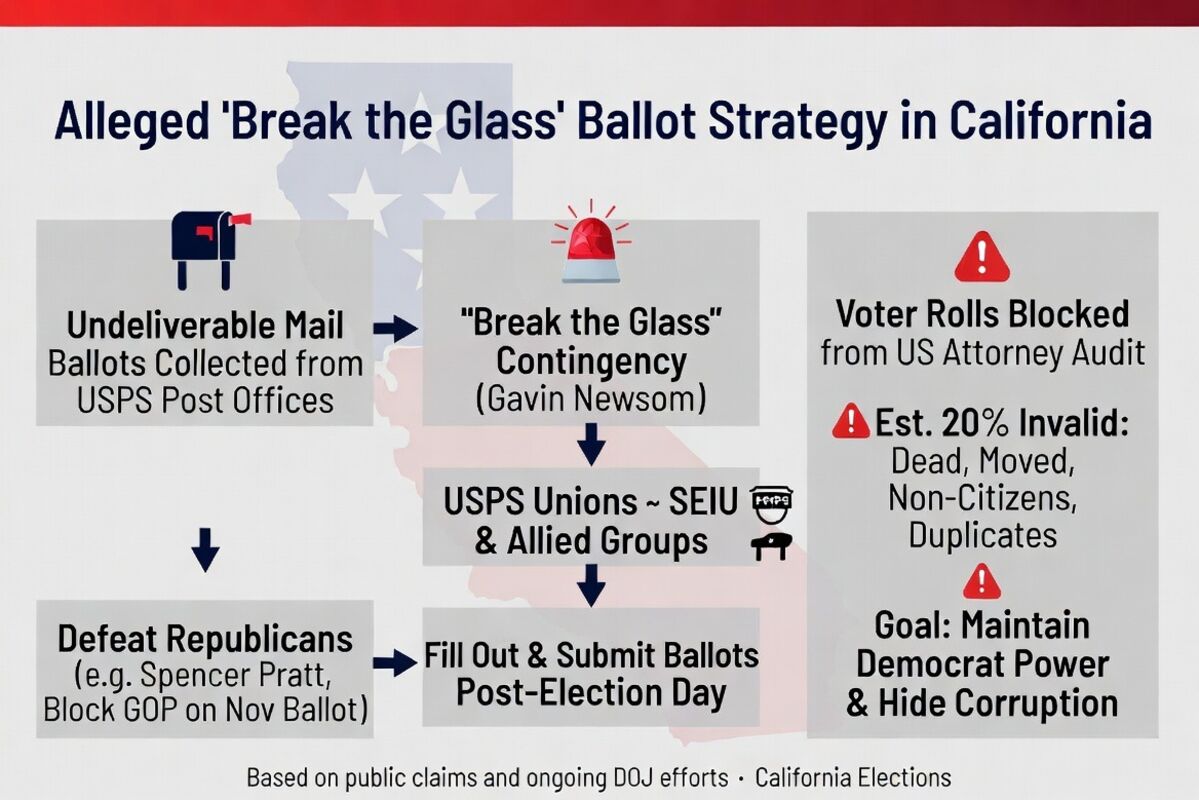
In the wake of the June 2026 California primary elections, particularly the closely watched Los Angeles mayoral race, a provocative theory has gained traction among election integrity advocates. It posits a coordinated system in which Democratic operatives and allied organizations systematically exploit California's expansive mail-in voting infrastructure to maintain political dominance. According to this view, undeliverable or unreturned ballots are collected and held in reserve, only to be activated post-Election Day if needed to "break the glass" in tight contests-echoing Governor Gavin Newsom's own phrasing.
The theory further alleges that unionized U.S. Postal Service workers facilitate the transfer of these ballots to groups like the SEIU, which then complete and submit them to flip results against Republican candidates. This is enabled by California's resistance to federal audits of its voter rolls, which critics claim contain high percentages of invalid registrations (dead voters, out-of-state movers, non-citizens). Proponents tie it directly to observed late-ballot surges that altered outcomes in LA and other races.
The Theory in Detail
California's "Break the Glass" Election Controversy: Theory, Evidence, and Ongoing Probes
At its core, the assertion-shared with me by Florida U.S. Senate candidate and election integrity activist Chris Gleason-describes a contingency mechanism: California Democrats harvest and stockpile problematic or undeliverable mail ballots through post office networks. In a "break the glass" scenario (a term Newsom used publicly regarding potential Republican advances in top-two primaries), these ballots are filled out after initial counts and submitted to secure victories. This allegedly explains dramatic late shifts favoring Democrats and the state's pushback against DOJ scrutiny. The motive, per advocates, is to conceal widespread roll inaccuracies and prevent exposure of policy failures under sustained Republican oversight in America's most populous state.
Evidence Supporting the Theory Several documented elements lend circumstantial weight to skepticism:
- Newsom's "Break the Glass" Comment: In May 2026, Governor Newsom explicitly referenced a contingency plan to prevent two Republicans from advancing in the gubernatorial primary under California's top-two system. He described behind-the-scenes efforts and a "deep understanding" of scenarios where Democrats could be "locked out," vowing to "do everything" to prevent it. While framed by his office as voter mobilization, critics interpreted it as signaling willingness to use extraordinary measures amid slow counting.
- Late Mail-In Surges in LA: In the LA mayoral primary, reality TV star and Trump-endorsed candidate Spencer Pratt held an early lead but was overtaken by progressive Councilmember Nithya Raman after days of late-counted mail ballots. Similar patterns flipped a sales tax measure. Mail ballots, often returned late and processed over subsequent days, heavily favored Democrats-a known demographic trend but one that fuels optics concerns in a universal mail-in state.
- Voter Roll Concerns and Federal Pushback: The DOJ, under Assistant Attorney General Harmeet Dhillon and U.S. Attorney Bill Essayli in California, is actively litigating for full access to voter rolls and investigating irregularities. Essayli has publicly stated there is evidence of fraud, expects charges, and highlighted resistance to audits. A 2025 Public Interest Legal Foundation analysis of California samples identified nearly 95,000 deceased registrants, duplicates, and placeholder birthdates. Nationwide studies have long flagged maintenance issues.
- Ballot Harvesting Legal Framework: California uniquely permits third-party collection of ballots (with limits on per-ballot pay). Critics, including congressional Republicans, argue this creates chain-of-custody vulnerabilities ripe for abuse, citing past isolated incidents and patterns in union-heavy areas.
Counter-Evidence and Official Rebuttals: Election officials, Democrats, and many independent analysts reject the coordinated fraud narrative as unsubstantiated:
- Newsom's Intent: Administration sources and fact-checks clarify the comment referred to pre-election get-out-the-vote efforts and rallying supporters, not post-election ballot fabrication. No recordings or documents detail illicit "breaking glass" tactics.
- Transparent, Legal Counting: Late mail ballots are statutorily countable if postmarked by Election Day and received shortly after. The Democratic lean reflects voter behavior (Democrats more likely to use mail and return late) and is fully auditable. LA County officials report no irregularities; shifts are routine in mail-heavy systems. Pratt himself has not pursued widespread fraud claims aggressively.
- **Scale of Proven Fraud**: While roll inaccuracies exist, studies and court reviews consistently find actual illegal voting (non-citizens, dead voters casting ballots) at tiny fractions-often under 0.01% in investigated cases. No whistleblower evidence, forensic audits, or prosecutions have validated systematic collection/filling of undeliverable ballots or USPS-SEIU handoffs. Claims remain anecdotal.
- **Privacy and Authority Concerns**: California officials argue DOJ demands exceed federal authority (Help America Vote Act) and risk voter privacy/intimidation. They maintain robust audits and note successful defenses in prior challenges.
Context and Implications
California's system-universal mail ballots, ballot harvesting, and extended counting-prioritizes access but invites scrutiny, especially with union involvement in elections and polarized outcomes. Ongoing federal investigations by Essayli's office could yield charges or clarity. For now, the "break the glass" theory highlights genuine vulnerabilities in roll maintenance and process transparency but lacks smoking-gun proof of the grand conspiracy alleged.
Voters deserve elections beyond reproach. Greater audit access, chain-of-custody reforms, and timely counting could address legitimate concerns without undermining participation. As probes continue, Californians-regardless of party-should demand evidence-based reforms over partisan recriminations.


Reader Comments(0)