
Community, Diversity, Sustainability and other Overused Words


Community, Diversity, Sustainability and other Overused Words
Critics of the government called it an invasion, saying that 30,000 or more migrants had illegally crossed the border.
Ceuta, a small Spanish autonomous city on the North African coast, is facing a sharp rise in irregular migrant arrivals from neighboring Morocco.
Critics of the government called it an invasion, saying that 30,000 or more migrants had illegally crossed the border.
Ceuta is a small Spanish peninsula (~18.5 km²) on the North African coast. It shares a short land border (~6–8 km) with Morocco's M'diq-Fnideq prefecture. Fnideq (Castillejos) lies immediately south of the border. The Tarajal area (southern tip) is the main coastal border point with the breakwater often used in sea crossings. Monte Hacho sits at the eastern end of the peninsula. The Strait of Gibraltar lies roughly 14–17 km to the north, separating it from mainland Spain.
Update, 8/1/26: Of 60,000 migrants who swam and ran into Ceuta, all but 2000 have voluntarily returned to Morocco, walking back through the open gate. They had little choice practically speaking, given that the Santa Monica sized territory had insufficient resources to feed and house them. The 2000 who remain are mostly minors who do have the right, under Spanish law, to remain. Some locals dispute that 58,000 have returned, but this is the official government figure. 57 migrants died in the rush to enter Ceuta on 7/30, either drowned or stampeded to death.
Ceuta, a small Spanish autonomous city on the North African coast, is facing a sharp rise in irregular migrant arrivals from neighboring Morocco. The territory sits on a narrow peninsula of roughly 18.5 square kilometers, bordered by Morocco to the south and surrounded by sea on the other sides. It lies just across the Strait of Gibraltar from mainland Spain-about 14 to 17 kilometers away-and, together with Melilla farther east, forms the European Union's only land borders with Africa. This unique geographic position has long made it a focal point for migration attempts into Europe.
In late July 2026, local authorities reported that between 1,500 and more than 2,000 people had entered Ceuta in roughly a week to 10 days, primarily by swimming or using flotation devices from the Moroccan town of Fnideq (also known as Castillejos). Critics of the government called it an invasion, saying that 30,000 or more migrants had illegally crossed the border.

Critics of the government called it an invasion, saying that 30,000 or more migrants had illegally crossed the border.
Additional attempts continued, with some reports of people scaling fences. Reception centers quickly became overwhelmed, with hundreds sleeping outdoors and facilities for unaccompanied minors operating far beyond capacity. Ceuta's president, Juan Jesús Vivas, described the situation as an "absolute humanitarian and social emergency" and formally asked the central government in Madrid to declare a national emergency, assume unified command, and consider deploying additional security forces, including the army.
Spain's national government, led by Prime Minister Pedro Sánchez of the Spanish Socialist Workers' Party (PSOE)-a left-leaning social-democratic party-declined the request for a formal national emergency declaration. The Interior Ministry stated that existing civil protection legislation does not classify migratory flows as a risk eligible for such a measure, which is reserved for natural or technological disasters. Officials said additional resources, personnel, and coordination with Moroccan authorities were already being mobilized. Interior Minister Fernando Grande-Marlaska planned to visit Ceuta to assess the situation. Spanish and Moroccan authorities separately agreed on arrangements for the urgent return of many of those who had recently crossed.
Reports consistently describe the majority of the recent arrivals as young men, primarily of Moroccan origin, with smaller numbers from Algeria or sub-Saharan Africa. Women, children, and unaccompanied minors have also been present, but young adult males form the bulk of the groups. Given the bilateral agreement on returns and standard procedures for irregular entries from Morocco, most of these individuals are expected to be repatriated rather than remaining in Spain.
The episode recalls earlier surges, including the large influx of 2021, and highlights the persistent pressures at this narrow European foothold on the African continent. Local services in the densely populated city of around 85,000 remain under significant strain as authorities work to manage both the immediate humanitarian needs and border controls.
Civil Guard officials warning of border "total collapse" after recent storms damaged fences, with thousands of mostly military-aged African men crossing by sea and land in hours.
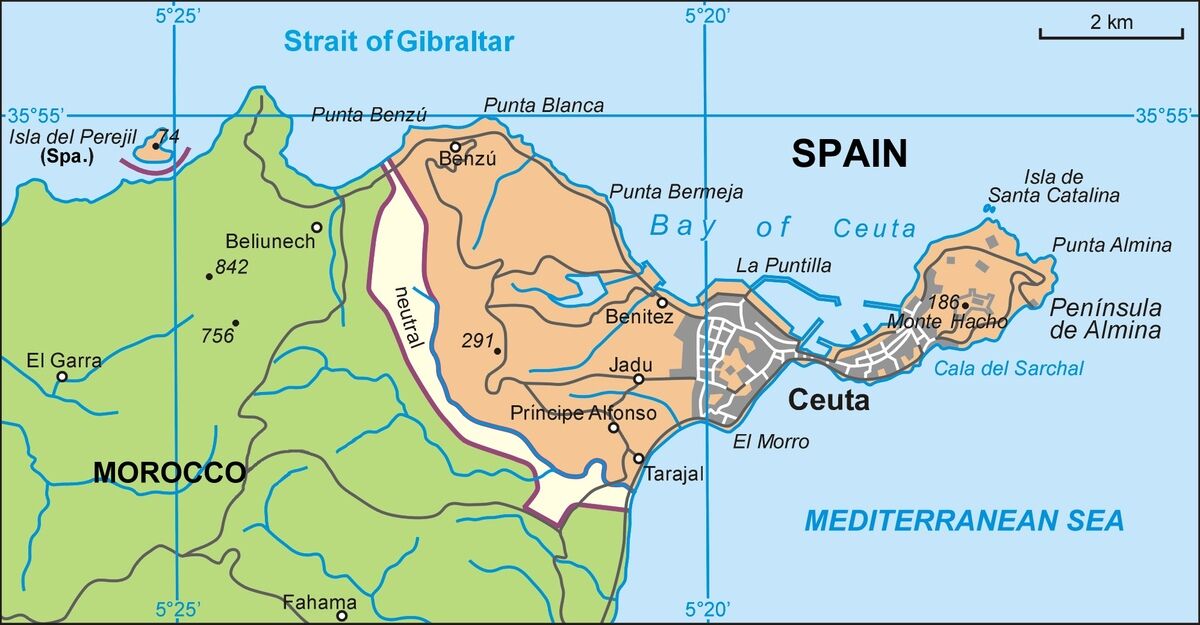
Ceuta is a small Spanish peninsula (~18.5 km²) on the North African coast. It shares a short land border (~6–8 km) with Morocco's M'diq-Fnideq prefecture. Fnideq (Castillejos) lies immediately south of the border. The Tarajal area (southern tip) is the main coastal border point with the breakwater often used in sea crossings. Monte Hacho sits at the eastern end of the peninsula. The Strait of Gibraltar lies roughly 14–17 km to the north, separating it from mainland Spain.
Spain completed a large 2026 regularization program in June, approving one-year renewable permits for over 1 million undocumented migrants who had been in the country for at least five months, a policy critics link to increased border pressure as a perceived pull factor.
Ceuta is a small Spanish peninsula (~18.5 km²) on the North African coast.
It shares a short land border (~6–8 km) with Morocco’s M’diq-Fnideq prefecture.
Fnideq (Castillejos) lies immediately south of the border.
The Tarajal area (southern tip) is the main coastal border point with the breakwater often used in sea crossings.
Monte Hacho sits at the eastern end of the peninsula.
The Strait of Gibraltar lies roughly 14–17 km to the north, separating it from mainland Spain.



Reader Comments(0)