
Community, Diversity, Sustainability and other Overused Words


Community, Diversity, Sustainability and other Overused Words
5.0 magnitude shaker struck at 9:30 am PST and lasted around 20 seconds. Social media posts described it as a strong or sudden jolt-some calling it the strongest they had felt in recent years
Moderate Earthquake Rattles Los Angeles Area Saturday Morning, Felt Strongly in Santa Monica and South Bay
List of aftershocks
Updated Nov. 28, 2026 - A magnitude 5.0 earthquake struck offshore in Santa Monica Bay on Saturday morning, November 28, 2026, at 9:30 a.m. PST, sending a noticeable jolt through much of the Los Angeles region, including Santa Monica, Manhattan Beach, Hermosa Beach, Redondo Beach, El Segundo, Inglewood, and surrounding communities.
According to the U.S. Geological Survey (USGS), the event has been reviewed at a magnitude of 5.0 (moment magnitude). It occurred at 17:30:29 UTC, approximately 6 km (about 3.7 miles) west-southwest of Manhattan Beach, California, at a depth of 12.2 km (about 7.6 miles). The epicenter lies under Santa Monica Bay, offshore from the South Bay coastline. Early automated estimates fluctuated (initially higher in some reports, then revised downward before settling at 5.0).
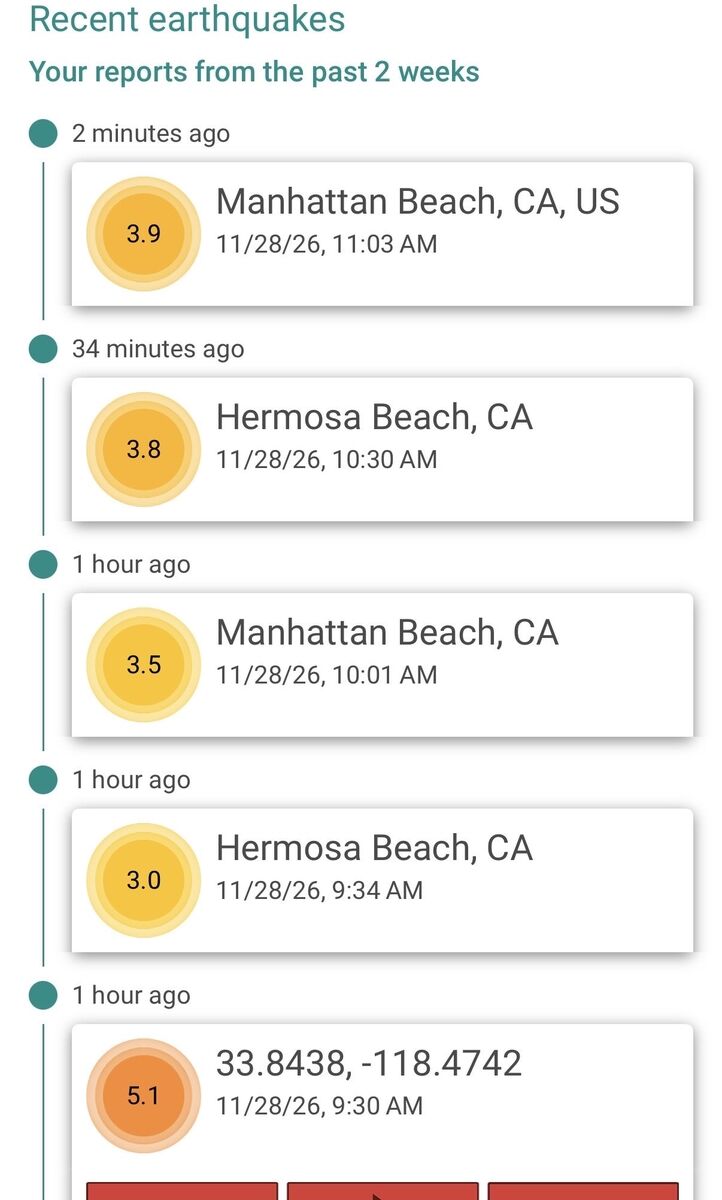
List of aftershocks
Residents across the greater Los Angeles area widely reported feeling the shaking. Social media posts described it as a strong or sudden jolt-some calling it the strongest they had felt in recent years-while others noted rattling windows, swaying trees, and items falling from shelves. Thousands of "Did You Feel It?" reports poured in (more than 13,000 to nearly 20,000 by mid-morning in various tallies), with maximum estimated intensity around V (moderate) on the Modified Mercalli scale near the epicenter. No tsunami warning was issued.
At this magnitude and offshore/deeper location, significant structural damage is generally not expected in modern California buildings. As of the latest reports, there were no confirmed injuries or widespread major damage. The Los Angeles Fire Department activated "earthquake mode," with personnel from all 106 neighborhood stations conducting strategic surveys by land, air, and sea of critical infrastructure. Mayor Karen Bass noted the quake was felt across Los Angeles and urged residents to drop, cover, and hold on while preparing for aftershocks. Seismologist Lucy Jones (Caltech) described it as one of the larger events in the L.A. area in some time-the biggest in the L.A. County-Orange County metro area since a magnitude 5.1 near Brea in 2014-and said major damage was highly improbable due to the offshore location and depth.
A plume of black smoke and visible flaring rose from the Chevron El Segundo refinery shortly after the quake, prompting an alert from the city that the facility was experiencing a "contingency flaring incident." Firefighters from El Segundo and Manhattan Beach responded. Officials indicated this was a routine safety procedure (automatic equipment shutdowns route excess gas to flares during process interruptions such as earthquakes), not evidence of structural damage from the quake. Nearby shoppers and employees were briefly escorted outside; no major building damage was reported in the immediate area.
At LAX, some ceiling tiles fell and alarms sounded during the shaking. Videos and eyewitness accounts also showed glass breaking in terminal areas, with shattered panes and debris on floors in at least one terminal; crews cleaned up the glass while airport operations continued with only brief disruptions.
Multiple aftershocks followed and continued to rattle nerves across the South Bay and greater Los Angeles area throughout the day. These included magnitudes around 3.0 (near Hermosa Beach shortly after the mainshock), several in the 3.7 range, a magnitude 4.5 near Hermosa Beach at 11:41 a.m., and others in the 2–3 range. The Southern California Seismic Network logged numerous smaller events-dozens overall by midday, with reports of at least 40. USGS aftershock forecasts indicated a roughly 29% chance of a magnitude 4+ and about 4% chance of a magnitude 5+ in the following week, with higher odds for smaller events. The ShakeAlert early warning system was activated.
This quake follows a period of elevated seismic activity in Southern California. In the preceding week, the region experienced several smaller events, including a magnitude ~3.9 near Commerce on November 20 that was widely felt, and a magnitude 3.3 offshore near Manhattan Beach on November 22. Southern California sits along a complex network of faults, including the nearby Palos Verdes fault zone (the most likely association for this event). While a magnitude 5.0 is moderate by California standards and far smaller than the region's potential for a major quake, it serves as a reminder of seismic risks. Residents are encouraged to maintain preparedness: drop, cover, and hold on during shaking; secure heavy furniture and water heaters; and have emergency supplies ready for at least several days.
USGS and the Southern California Seismic Network continue to monitor the area. Residents who felt the earthquake are encouraged to submit reports via the USGS "Did You Feel It?" system to help refine shaking intensity maps. Information is based on reviewed USGS data and local reports and is subject to further updates.



Reader Comments(0)