
Community, Diversity, Sustainability and other Overused Words


Community, Diversity, Sustainability and other Overused Words
No stranger to controversy, Scott Adams supported Trump, and says life was never the same for him afterwards.
Scott Adams died January 13, 2026, of prostate cancer. Here he is eulogized by Greg Gutfeld.
An interview with Scott Adams, #WINNING: Dilbert Creator SCOTT ADAMS on DONALD TRUMP, Success & How to WIN BIGLY!! (Ep. 8 | S. 6)
King of the Cubicle Comic, Scott Adams Passes After Brave Fight With Prostate Cancer. He Was 68
Scott Adams (June 8, 1957 – January 13, 2026) was an American cartoonist, author, and commentator best known as the creator of the Dilbert comic strip.
Early Life and Career--Born in Windham, New York, Adams began drawing cartoons as a child, inspired by Peanuts.
He earned a BA in economics from Hartwick College (1979) and an MBA from UC Berkeley (1986). He worked in corporate roles, including as a teller at Crocker National Bank (where he was held up at gunpoint twice) and later at Pacific Bell in various tech and finance positions until 1995. These office experiences directly inspired his satirical take on corporate bureaucracy.
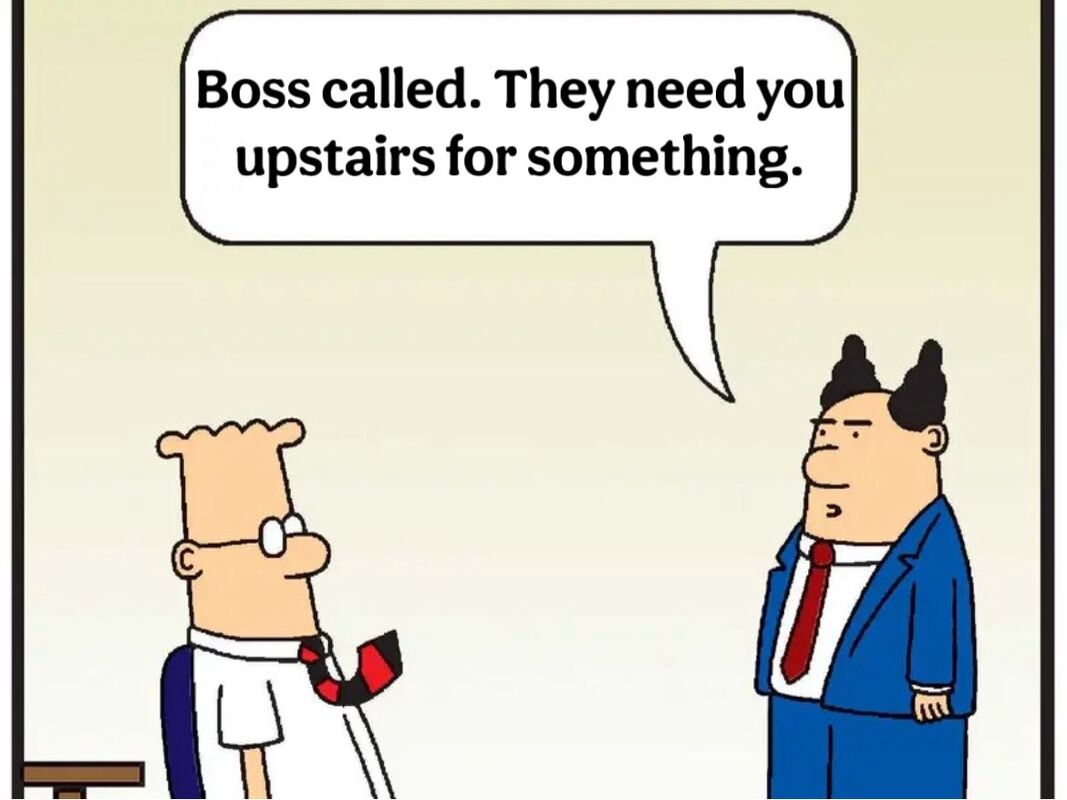
Adams launched Dilbert in 1989, a three-panel comic strip featuring the hapless engineer Dilbert, his clueless Pointy-Haired Boss, and absurd workplace antics. It exploded in popularity:Syndicated in thousands of newspapers (peaking at over 2,000 in 57 countries and 25+ languages).
Spawned bestselling books like The Dilbert Principle (1996), which mocked incompetent management. Won the National Cartoonists Society's Reuben Award (1997).
Adapted into a UPN animated series (1999–2000), which Adams executive-produced. Generated merchandise, including the short-lived Dilberito burrito.
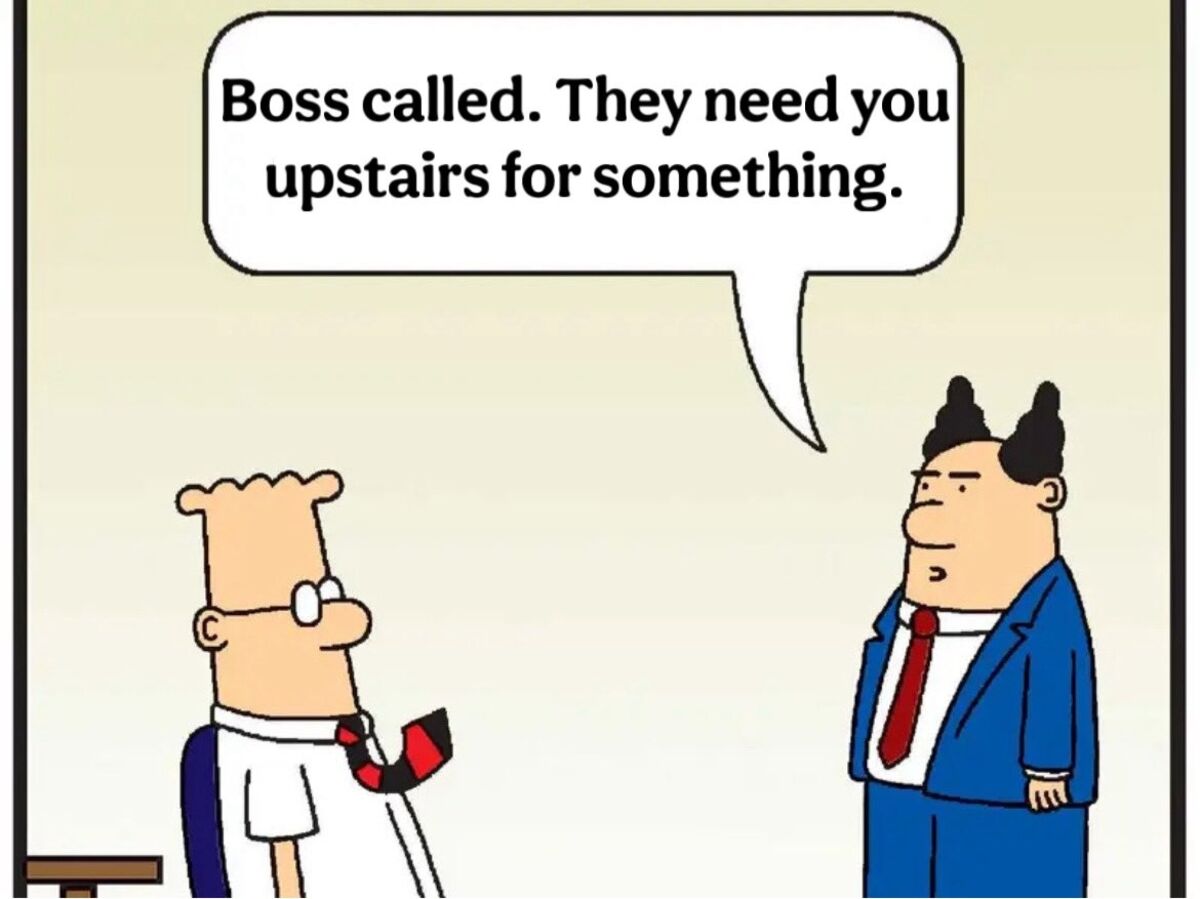
He became a full-time cartoonist in 1995 and wrote influential nonfiction books on success, persuasion, and systems thinking (e.g., How to Fail at Almost Everything and Still Win Big (2013), Win Bigly (2017)).Later Career and ControversiesFrom 2015 onward, Adams shifted toward political commentary, endorsing Donald Trump early (predicting his 2016 win via "persuasion" skills) and hosting the daily YouTube/podcast show Real Coffee with Scott Adams (later The Scott Adams School).
He faced backlash for views on COVID vaccines, masking, and other topics. In February 2023, after calling Black people a "hate group" on his livestream (in response to a poll) and advising white people to "get the hell away," hundreds of newspapers and his syndicate dropped Dilbert. He relaunched it as Dilbert Reborn on his subscription platform Locals and continued online content until his death.
Health Struggles and DeathAdams battled several conditions earlier in life, including focal dystonia (affecting his drawing hand) and spasmodic dysphonia (treated surgically).In May 2025, he publicly announced an aggressive, metastatic prostate cancer that had spread to his bones (noting it was the same type former President Biden disclosed around the same time). He documented his treatments (including testosterone blockers, radiation, and appeals for drugs like Pluvicto, even seeking help via Trump allies in late 2025). By December 2025, complications included paralysis below the waist, heart failure, and severe pain.
On New Year's Day 2026 (January 1), he recorded a farewell message on his podcast, warning viewers January would likely be a "month of transition" with "essentially zero" recovery odds, and prepared a final written statement reflecting on his life, marriages, career evolution from cartoonist to author/podcaster, and gratitude: "My body failed before my brain... I had an amazing life. I gave it everything I had... Be useful, and please know I loved you all to the very end."
He died peacefully under hospice care at his home in Pleasanton, California, on January 13, 2026, at age 68. His ex-wife Shelly Miles announced the death during a livestream of his show, reading his prepared message.
He had no biological children, was twice married/divorced (most recently to Kristina Basham, 2020–2022), and shortly before death announced his pragmatic conversion to Christianity.
Adams left a complex legacy: beloved for making office drudgery hilarious and relatable for millions, yet polarizing for his later provocative commentary. His influence endures through Dilbert's cultural satire and his books on personal effectiveness.
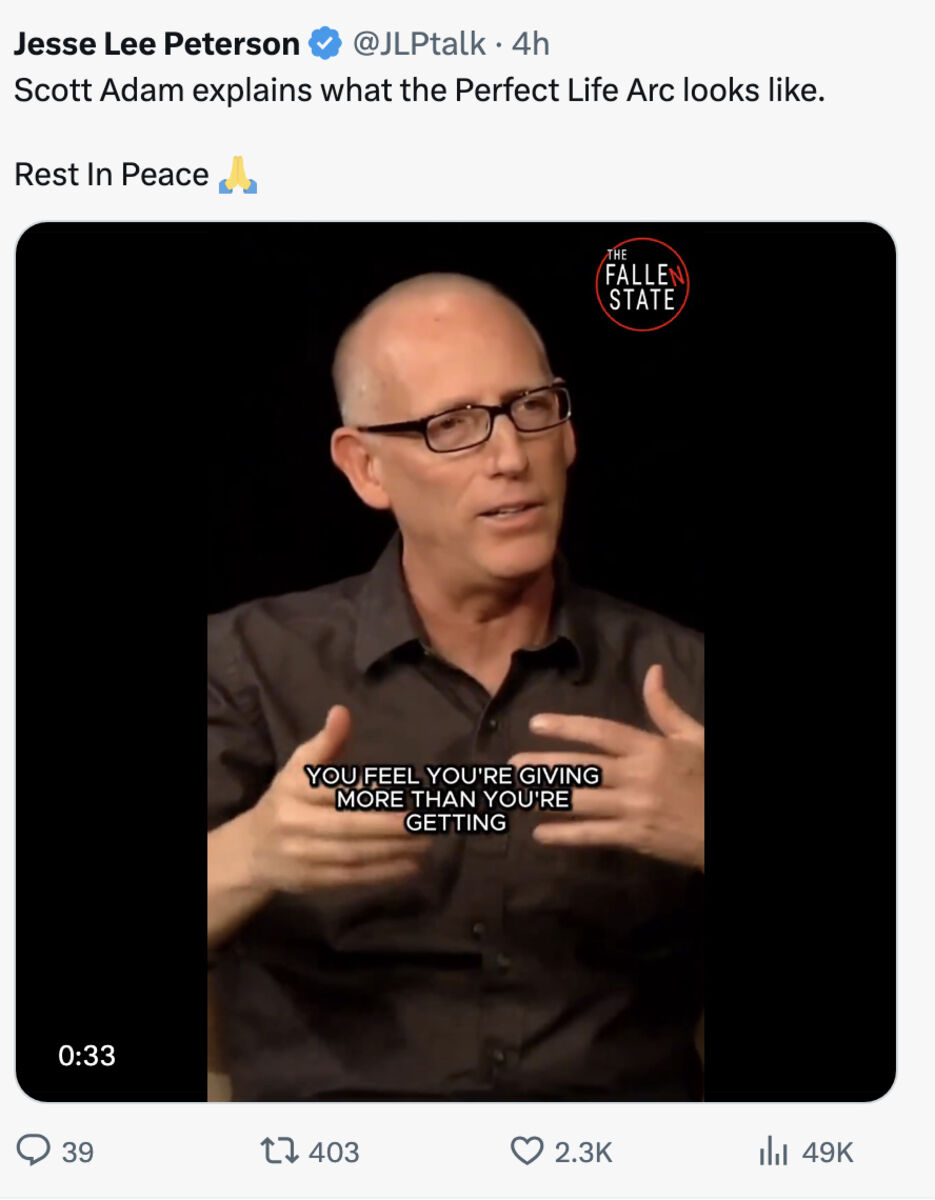
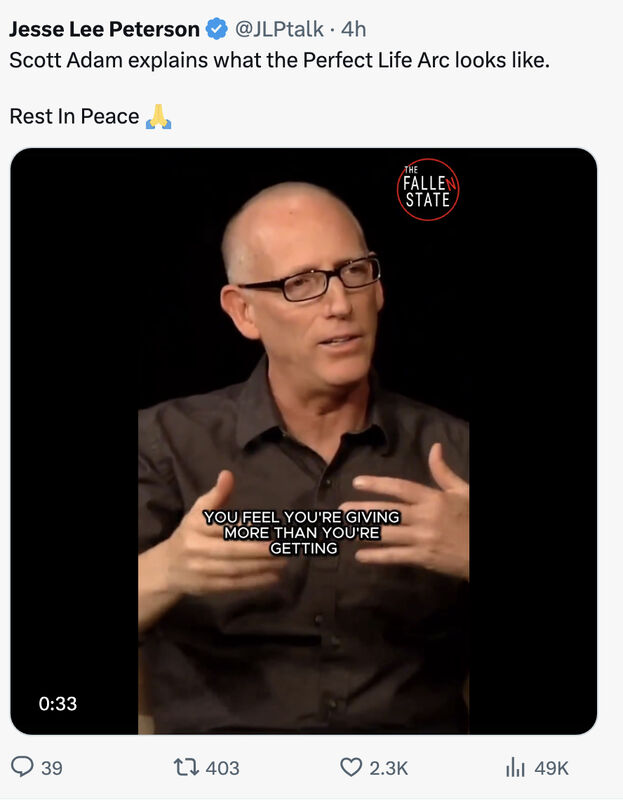
King of the Cubicle Comic, Scott Adams Passes After Brave Fight With Prostate Cancer. He Was 68
A Tribute in the Style of Greg Gutfeld: Farewell to Scott Adams, the Guy Who Saw the Cubicle for What It Really Was
Folks, if you're tuning in tonight expecting the usual cocktail of outrage, snark, and questionable life advice, buckle up-because tonight we're raising a glass (or three) to a man who made corporate hell funny long before it became fashionable to hate your boss.
Scott Adams died today, January 13, 2026, at 68, after a brutal fight with metastatic prostate cancer. He went out the way he lived: clear-headed, writing his own final message on New Year's Day like a guy dictating terms to the universe itself. "My body failed before my brain," he said. "I had an amazing life. I gave it everything I had." That's not defeat; that's a mic drop from a guy who spent decades dropping truth bombs in three-panel increments.
I knew Scott. We talked on my old show, on podcasts, over coffee-real coffee, not the watered-down corporate sludge Dilbert would have mocked. He was sharp, funny, and utterly unafraid. The creator of Dilbert didn't just draw cartoons; he weaponized them. He took the soul-crushing absurdity of office life-the pointless meetings, the jargon, the bosses who rose to their level of incompetence-and turned it into a mirror we all recognized. And laughed at. Because what else are you gonna do when Pointy-Haired Boss asks for another paradigm shift?
An interview with Scott Adams, #WINNING: Dilbert Creator SCOTT ADAMS on DONALD TRUMP, Success & How to WIN BIGLY!! (Ep. 8 | S. 6)
Scott was the patron saint of the cubicle dweller. He gave voice to the quiet rage of the talented trapped under layers of middle management. He wrote books like The Dilbert Principle that basically said: companies promote the useless to management so they can't do real damage. And we all nodded, because we'd lived it.
Sure, he got controversial later. He went full persuasion mode, dissected politics like a hypnotist (which he actually was), and yeah, he said things that made the pearl-clutchers faint. In 2023, the syndicate dropped Dilbert faster than a bad intern drops a coffee on the CEO. Newspapers ran for the hills, calling him every name in the book. But Scott? He just moved online, kept drawing, kept talking, kept being Scott. No apologies, no groveling. He saw the game and played it his way.
And let's be honest: the same crowd that canceled him for being "problematic" is the same crowd that would have been the butt of his jokes in 1995. The sanctimonious HR department, the diversity seminars that accomplish nothing, the endless virtue-signaling. Scott saw through it all. He called it like he saw it, and in a world obsessed with feelings over facts, that made him dangerous.
But here's the thing: he was never mean for mean's sake. He was a truth-teller with a pen. And when cancer came knocking-aggressive, metastatic, the kind that laughs at treatment-he faced it the same way. No whining. He tried everything, from standard stuff to the wild cards, documented it all on his show. He even joked about it. Because that's what Scott did: he turned pain into perspective.
In his final note, he asked us to "be useful" and said he loved us all to the end. That's not the sign-off of a bitter man. That's the sign-off of someone who won at life.
So tonight, let's toast the guy who made Mondays bearable, who reminded us that the emperor has no clothes-and no TPS reports either. Scott Adams: cartoonist, provocateur, persuasion genius, friend. You made the absurd funny, the infuriating relatable, and the world a little less corporate.
Rest in peace, Scott. And if there's a heaven, I hope the angels have decent coffee and zero mandatory team-building exercises.
You'll be missed, big time.

Reader Comments(0)